What is trust accounting in property management?
A plain-English guide to holding other people's money properly — what trust accounting means, how it works day to day, and when a spreadsheet stops being enough.

Ryan J
Co-Founder, PropertyStack · · 9 min read
Contents
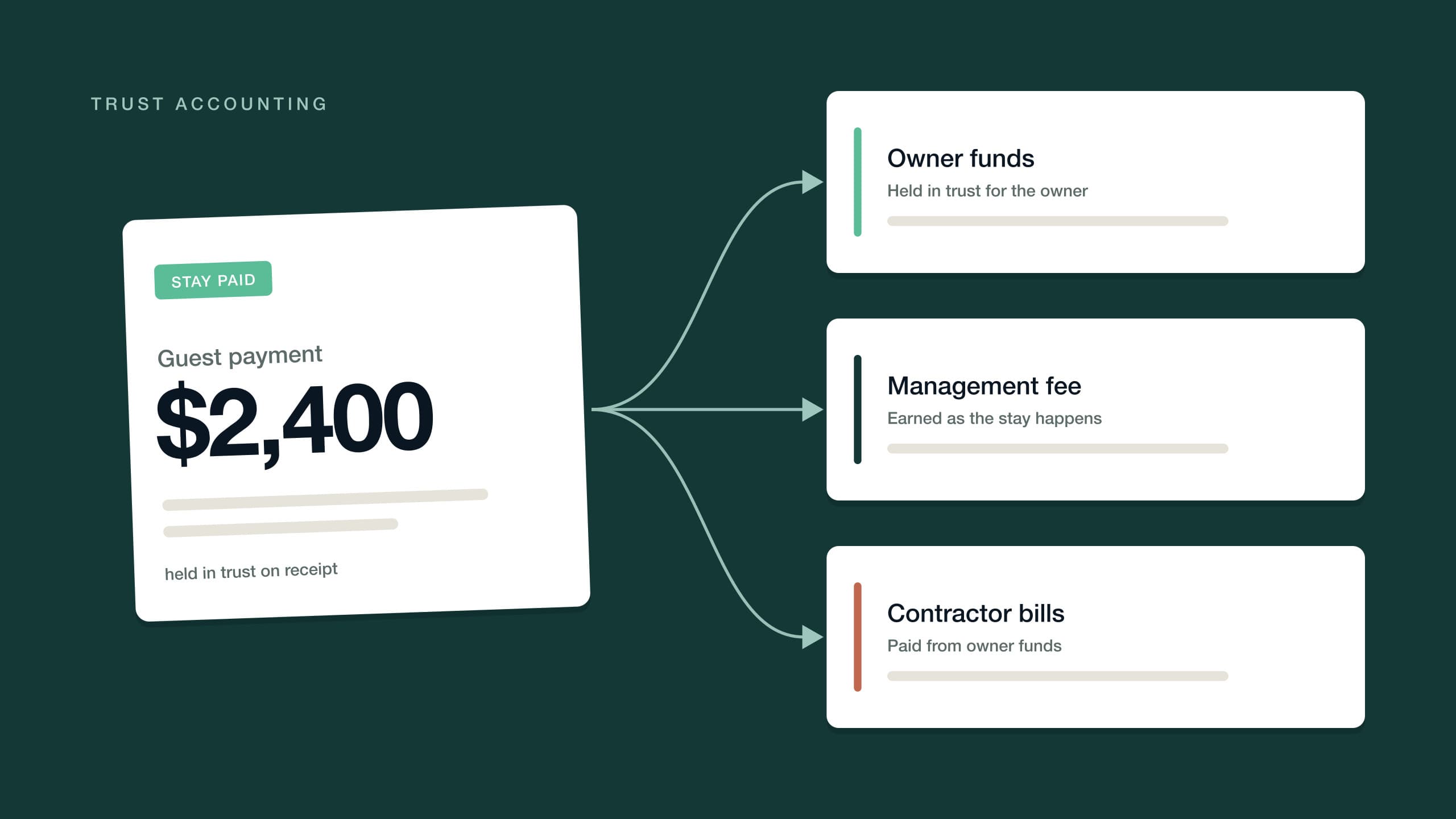
A guest books a two-week stay and pays $2,400 up front. How much of that money is yours? If you manage the property for an owner, the honest answer is: almost none of it, and not yet. Most of it belongs to the owner. Some of it will go to the cleaner and the pool contractor. Your management fee is in there somewhere — but you haven't earned it until the stay happens.
Trust accounting is the discipline that keeps all of that straight. It's one of the least glamorous parts of managing rentals on someone else's behalf, and one of the fastest ways to lose an owner's confidence — or a license, where one is required — if you get it wrong. This explainer covers the concept; when you're ready to run it day to day, the complete trust accounting guide for short-term rentals is the operating manual.
What does trust accounting mean in property management?
In property management, trust accounting means receiving, holding and paying out money as a custodian rather than an owner. When a guest pays for a stay, the funds don't become the manager's revenue. They enter a trust: the manager holds them on behalf of the property owner (and, for deposits, sometimes the guest) until the management agreement says they can be released.
That single idea produces every rule that follows. Because the money isn't yours, it can't sit in your business checking account. Because different owners' money is pooled in one trust account, you need a separate ledger per owner — often per property — showing exactly whose dollars are whose. And because errors compound silently, you need a routine that regularly proves the bank, your records and those ledgers all agree.
Trust accounting applies to anyone managing rental income they don't own: property managers running portfolios for multiple owners, co-hosts collecting payouts on behalf of a host, and operators who guarantee rent and manage on top. If the only money moving through your accounts is your own, you don't need a trust — you need good bookkeeping. The moment client money enters the picture, the standard changes.
Why short-term rentals make trust accounting harder
Long-term rentals generate one predictable rent payment per month. Short-term rentals generate a stream of small, irregular, multi-party transactions — and each one touches the trust:
- Money arrives before it's earned. Guests prepay weeks or months ahead. Those funds sit in trust as unearned income until the stay actually happens.
- Channel payouts bundle reservations. A single Airbnb or Booking.com deposit can cover several bookings across several owners — it has to be split correctly on receipt.
- Every stay has costs attached. Cleaning fees, linen, consumables and contractor call-outs are paid from owner funds, each needing the right ledger.
- Refunds, adjustments and damage holds flow backwards. Cancellations and alteration credits reverse money that may already be allocated.
- Fees are earned in slices. Management commission, upsell shares and pass-through charges are deducted stay by stay, not once a month.
The volume is the trap. At five properties, a diligent manager can hold the model in their head. At thirty, hundreds of monthly transactions each need to land in the right ledger, and a $40 mis-allocation in March surfaces as an unexplainable $40 hole at the end of the financial year.
Trust account vs operating account: what's the difference?
The clearest way to understand trust accounting is to ask, for every dollar: whose money is this? Client money lives in the trust account; your money lives in your operating account. Moving money between the two is the most sensitive action in the whole system — it should only ever happen when a fee has genuinely been earned.
| Money | Account | Why |
|---|---|---|
| Guest prepayments and balances | Trust | Held for the owner (and partly the guest) until the stay occurs |
| Security deposits and damage holds | Trust | The guest's money unless a claim is made |
| Owner income awaiting disbursement | Trust | The owner's money until paid out |
| Contractor payments for owner-approved work | Trust (out) | Paid from the relevant owner's funds |
| Management fees, once earned | Operating | Your revenue — transferred from trust with a clear audit trail |
| Your payroll, rent and software | Operating | Business expenses never touch client money |
How trust accounting works day to day
A working trust accounting system is a loop of five habits. None of them is complicated on its own — the discipline is doing all five, continuously, without exception.
1. One ledger per owner
The trust bank account is one pool of money; the ledgers are the map of who it belongs to. Every owner (and usually every property) gets a ledger recording receipts in, payments out and the running balance. At any moment, the sum of all ledger balances must equal the money in the trust account — no more, no less.
2. Receipting money in
Every deposit — a channel payout, a direct-booking payment, an owner top-up for a renovation — is receipted against the right ledger the day it lands. Bundled channel payouts are split across the reservations they cover. Unallocated cash sitting in a trust account is a red flag, not a convenience.
3. Paying money out
Contractor invoices are paid from the owner's ledger they relate to, with the bill attached to the transaction. Owner disbursements — the regular payout of rental income — pull from each ledger with a statement explaining every line. Fees you've earned move to your operating account in the same disciplined way, never as an ad-hoc transfer.
4. Reconciling until it balances
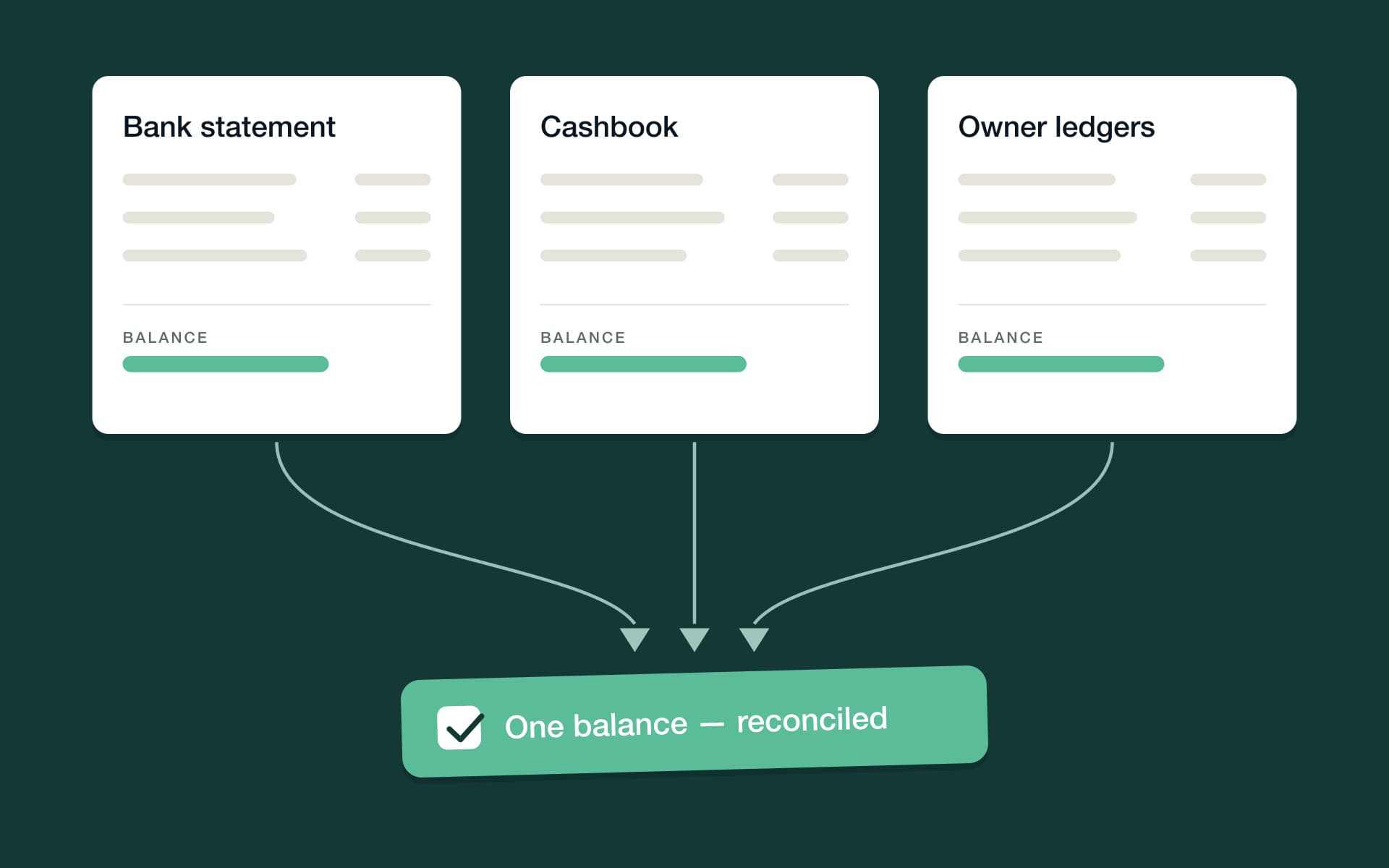
Reconciliation is where trust accounting earns its name. On a regular cycle — daily for busy portfolios — you prove that three views of the money agree: the bank statement, your cashbook of recorded transactions, and the sum of the owner ledgers. This is three-way reconciliation, and it's the single habit that catches errors while they're still small.
5. Reporting to owners
Owners see the result as a monthly statement: income per booking, expenses with invoices attached, fees deducted, net disbursement. Clear statements are as much a retention tool as an accounting artifact — an owner who understands every line has no reason to wonder what's happening to their money. A self-serve owner portal that shows statements, payouts and documents cuts most of the month-end questions before they're asked.
What is three-way reconciliation?
Three-way reconciliation is the process of matching the trust bank balance, the cashbook (your internal record of every receipt and payment) and the total of all owner ledgers, and investigating any difference until all three agree. Two-way reconciliation — bank against cashbook — proves you recorded what happened; adding the ledger dimension proves the money is also allocated correctly. A trust can pass a two-way check while quietly holding one owner's income in another owner's ledger; the three-way check is what surfaces it.
What happens if you get trust accounting wrong?
The failure modes are rarely dramatic at first. A payout split slightly wrong. A contractor paid from the wrong ledger. A fee transferred twice. Each is invisible in the moment because the trust account total still looks right — the errors live inside the allocation, and they compound.
The consequences arrive later, and on someone else's schedule. In many places, agencies and managers who hold client money are licensed and their trust accounts are audited — requirements vary by jurisdiction, so confirm the rules with your local regulator or industry body. Beyond any formal scrutiny, the practical costs are universal: hours of forensic spreadsheet archaeology at year end, owner conversations that start with "can you explain this line?", and the reputational damage of paying an owner late because the books wouldn't balance.
The trust account total can look perfectly healthy while the ledgers inside it are wrong. That's why reconciliation is a routine, not a year-end event.
Do you need trust accounting software?
Plenty of managers start with a spreadsheet, and at a handful of properties it can work. The spreadsheet fails predictably, though — usually at the same growth points:
- Channel payouts take real time to split across owners, and one formula error propagates silently.
- Month end grows from an afternoon to several days of matching bank lines by hand.
- Owner questions can't be answered without opening three files.
- Nobody else can safely run the process when you're away.
- An auditor or an owner's accountant asks for records the spreadsheet can't produce.
Purpose-built trust accounting software removes the mechanical failure points: receipts land against reservations automatically, ledgers can't drift from the bank because reconciliation is built into the daily workflow, and every transaction carries its paper trail. When you evaluate platforms, look for per-owner ledgers as a first-class concept, a proper three-way reconciliation view, disbursement runs with statements attached, and automated payment collection feeding the trust correctly from the moment a guest pays.
How PropertyStack handles trust accounting
PropertyStack, an agentic property management platform for short-term rentals, treats trust accounting as core infrastructure rather than an add-on. Trust accounting is built to be reconciled and audit-ready to your jurisdiction's standard: the reconciliation page shows bank, cashbook and ledger side by side, daily trust tasks keep the three-way balance current, and end-of-month runs handle disbursements and payouts with statements generated for every owner.
The AI accounting agent does the repetitive work inside those guardrails — it reconciles bank lines, pulls contractor bills from the portal into payables, generates and sends owner statements, and answers owner questions in the portal. You set the approval thresholds, so money movements that need human sign-off always get it.
Frequently asked questions
The short version, for the questions operators ask most.
A trust account is a dedicated bank account that holds money belonging to clients — guest prepayments, owner rental income, deposits — separate from the manager's own business funds. The manager administers it as a custodian, with a ledger tracking each owner's share.
It depends where you operate. Many jurisdictions require licensed agents or managers holding client money to use audited trust accounts; others don't regulate it directly. Requirements vary by jurisdiction, so confirm with your local regulator — and even where it isn't mandated, separating client money is best practice.
Three-way reconciliation proves that the trust bank balance, the cashbook of recorded transactions, and the sum of all owner ledgers agree. It goes beyond a standard bank reconciliation by verifying the money is not just recorded but allocated to the right owners.
At a small scale, carefully, yes — but spreadsheets have no guardrails: payout splits, ledger allocation and reconciliation all depend on manual discipline, and errors compound invisibly. Most managers outgrow spreadsheets well before they outgrow anything else in their stack.
Trust accounting in PropertyStack is built to be reconciled and audit-ready to your jurisdiction's standard, with per-owner ledgers, a bank-cashbook-ledger reconciliation view and end-of-month disbursement runs. The AI accounting agent reconciles bank lines, processes contractor bills and sends owner statements under thresholds you approve.
Still have questions?
Ask PropertyStack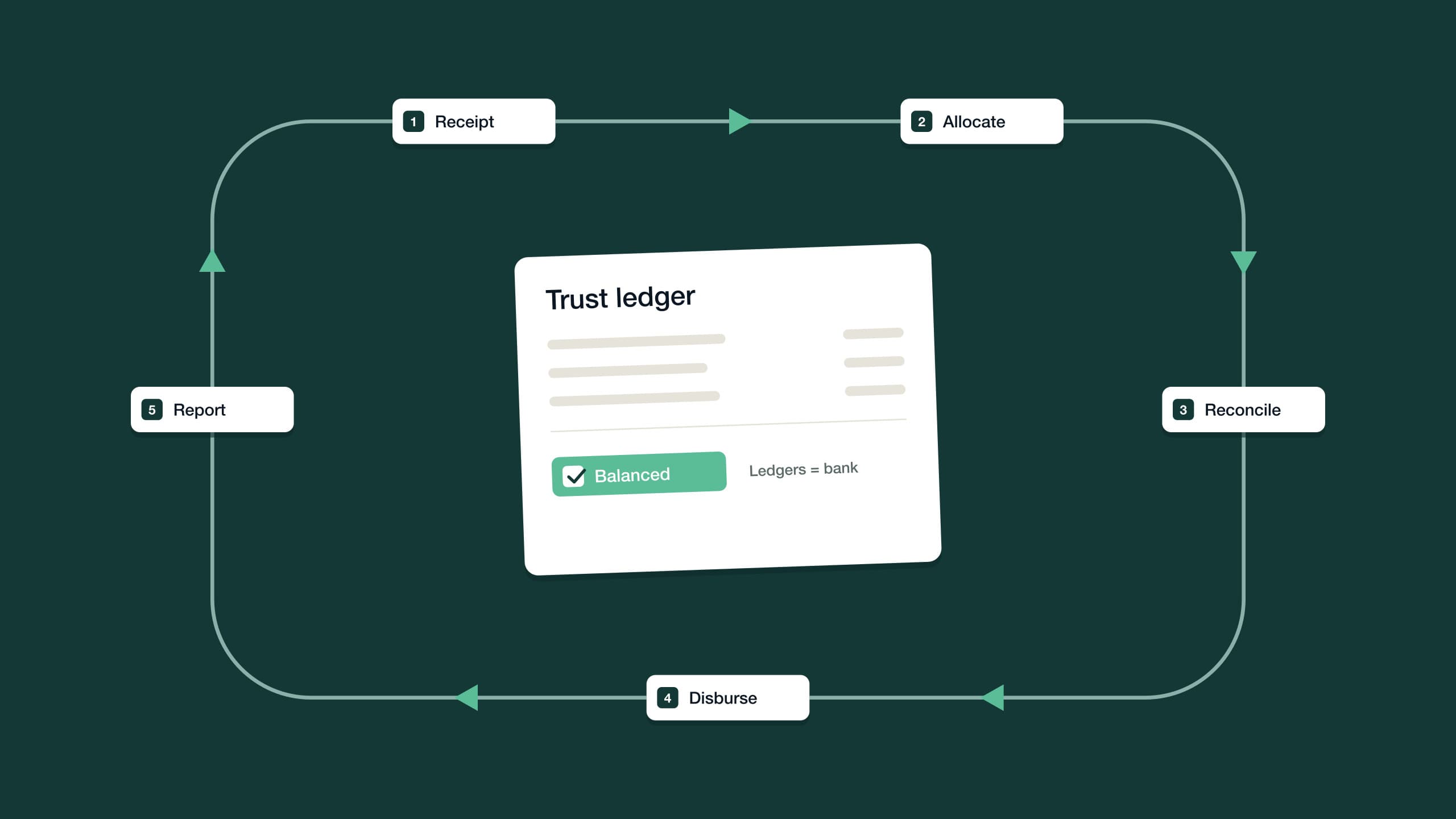

See it on your own listing. Free, from one link.
Paste an Airbnb listing and we'll show you what it could look like — a rewritten title, description, photos and a task list from your reviews.
- Syncs with every channel
- Cancel anytime
- AI agents with Pro