Trust accounting for short-term rentals: the complete guide
The operating manual for holding owner money properly — account and ledger setup, the daily receipting loop, three-way reconciliation, end of month step by step, and statements owners actually read.

Ryan J
Co-Founder, PropertyStack · · 18 min read
Contents
Your own money forgives you. Mis-code an expense in your business account and the worst case is a messy report and a raised eyebrow from your accountant. An owner's money forgives nothing — every dollar that moves through your hands belongs to someone who can ask, at any moment, exactly where it went, and expect an answer with a paper trail behind it. Managing money for owners isn't bookkeeping with higher stakes. It's a different job, with different rules, run on someone else's behalf.
That job is trust accounting in property management, and this guide is the operating manual for it: how to structure the accounts and ledgers, what to do every day, how reconciliation actually works, how to run end of month without losing a weekend to it, and what owners should see when it's done. If the concept itself is new — what a trust account is and why the money isn't yours — start with our plain-English explainer, what trust accounting is and why it exists, then come back here for the how.
Everything below applies whether you run the process in purpose-built software or, bravely, in a spreadsheet. The steps are identical; the only thing that changes is how much of the discipline you have to supply by willpower.
Setting up: the account and ledger structure
Good short term rental trust accounting is mostly structure. Get the accounts and ledgers right before the first booking and the daily work becomes mechanical; get them wrong and every later step inherits the confusion. There are three pieces to put in place: the bank accounts, the ledger structure, and the management agreement that governs how money moves between them.
Trust account vs operating account
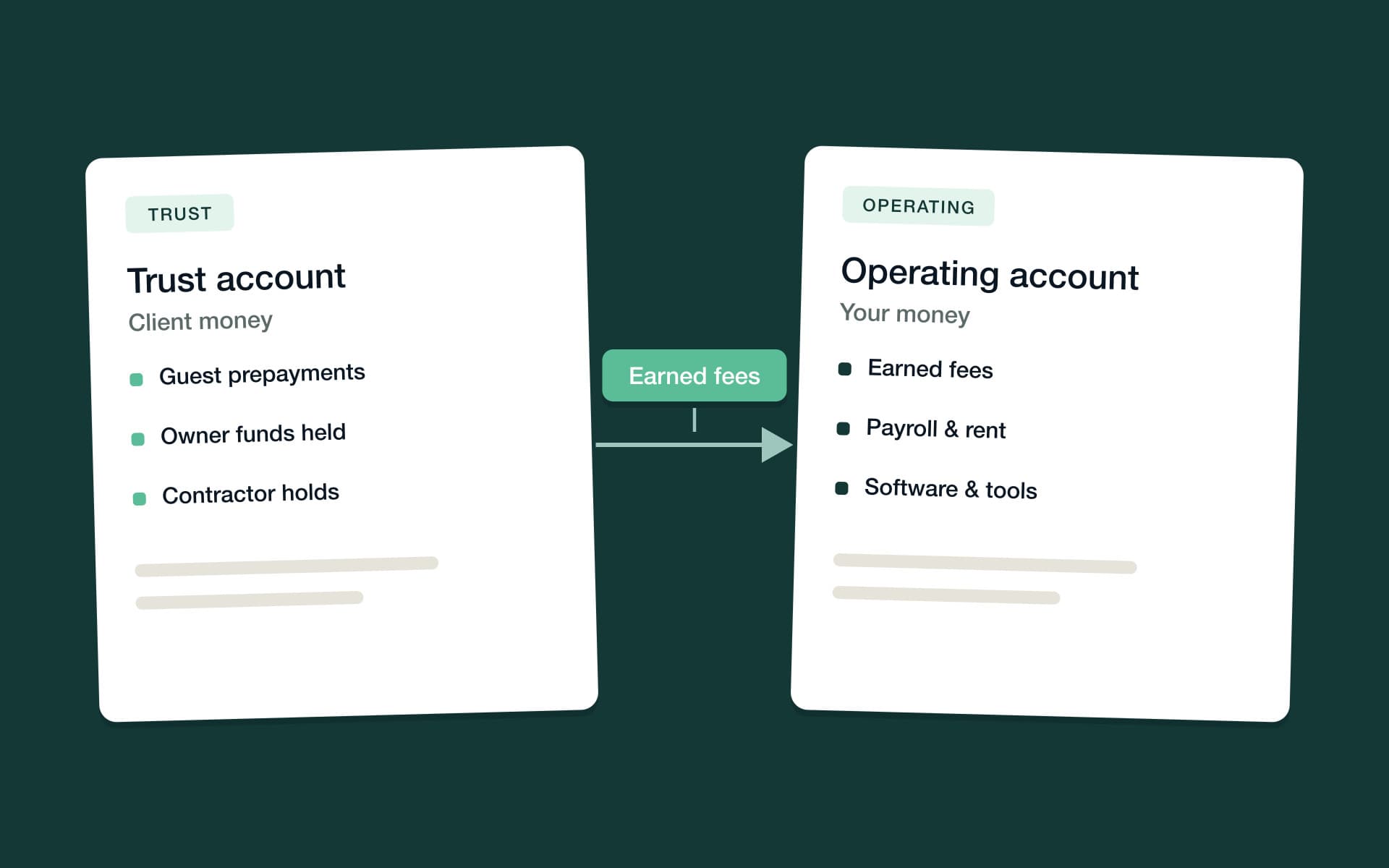
You need at least two bank accounts. The trust account holds client money: guest prepayments and deposits, owner funds awaiting disbursement, amounts set aside for contractor bills. The operating account holds your money: earned fees, and the payroll, rent and software you pay with them. The dividing question for every dollar is ownership, not convenience. Client money goes into trust the day it arrives and leaves only to pay an owner's bills, refund a guest, or disburse to the owner. Your fees cross from trust to operating only once they're earned — in a transaction that records what was earned and when.
Two habits protect that boundary. First, business expenses come out of operating without exception — even when a trust surplus makes borrowing tempting or a timing gap makes it convenient. Second, the fee transfer is a deliberate, documented event, not a sweep: earned fees move across with a record of the stays and agreements that earned them. In many places this boundary is regulated as well as sensible, and moving money across it wrongly is the most serious mistake a manager can make. Requirements vary by jurisdiction — confirm the rules that apply to you with your local regulator.
One ledger per owner, one per property
Inside the trust account, ledgers are the map of ownership. Every owner gets a ledger; where an owner has multiple properties, give each property its own, so one home's strong month never blurs into another's roof repair. Each ledger records money in, money out and a running balance — and the sum of every ledger balance must equal the trust bank balance at all times. That identity, ledgers equal bank, is the invariant the entire system exists to defend. Whether you pool client money in one trust account with ledgers inside it or hold separate accounts is an operational choice in some places and a regulated one in others — confirm which applies before you open the account.
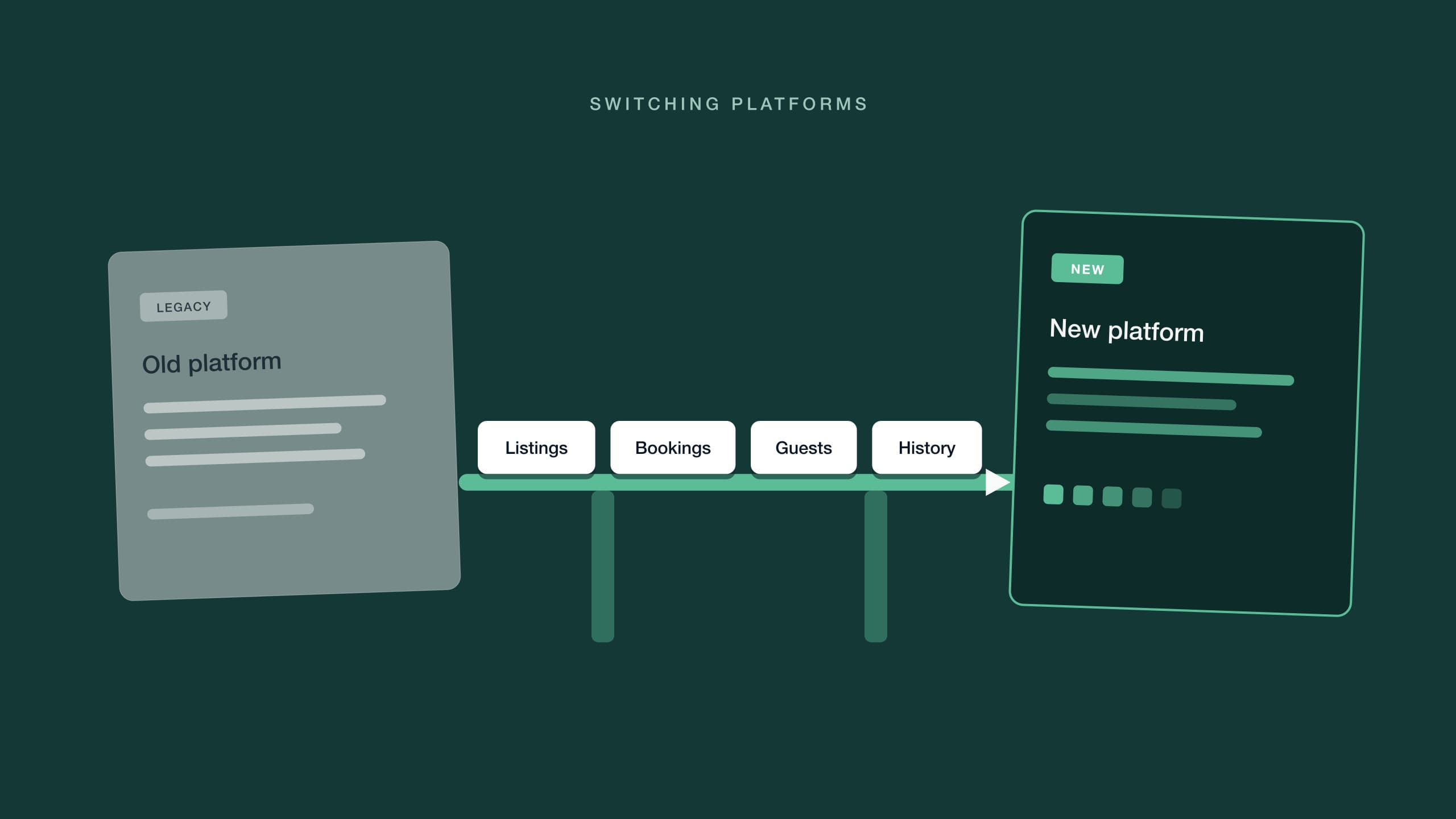
Set opening balances with care. If you're migrating from another system — or from the spreadsheet era — bring each owner's opening balance across as of a specific date, reconcile it against the bank on that date, and draw a line: everything before it lives in the old records, everything after lives here. A fuzzy opening balance haunts a trust account for years, surfacing as a small unexplainable difference in every reconciliation that follows.
What your management agreement should define
The management agreement is the rulebook your ledgers execute. Before software enters the picture, it should answer a short list of money questions in writing:
- Fees — the basis (commission on stays, flat, or a mix) and the precise moment a fee counts as earned.
- Disbursement timing — how often owners are paid, on what schedule, and to which account.
- Floats and reserves — whether each ledger keeps a working balance behind for bills that land between payouts.
- Spending authority — the maintenance amount you may approve without the owner's sign-off, and what happens above it.
- Pass-throughs — which costs are recharged to the owner at cost, and which are yours to absorb.
This isn't legal advice about what an agreement must contain — that depends on where and how you operate. It's an operational point: every one of those answers becomes a rule your trust accounting applies every single month. Vague agreements produce vague ledgers, and vague ledgers produce the owner phone calls you least enjoy.
The daily loop: receipt, allocate, zero
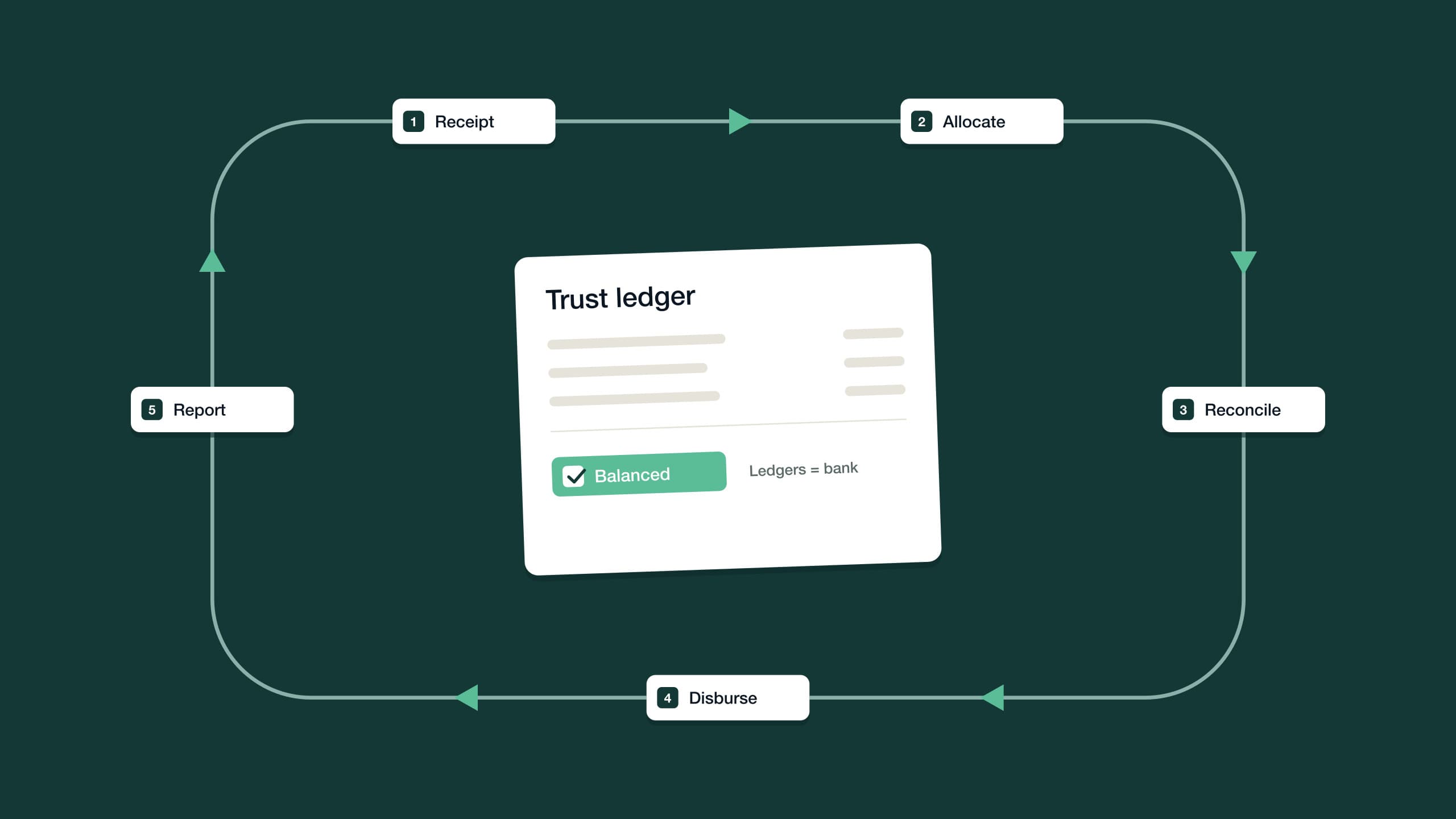
Trust accounting fails in daily increments, so it has to be run in daily increments. The loop is short — receipt what arrived, allocate it to the right ledgers, process what's due to go out, end the day with nothing unallocated — and on a well-structured portfolio it's a routine, not a project. Skipping a day doesn't remove the work; it compounds it, with the interest payable at end of month.
Treat the loop like a shift, not a hobby. It needs a named owner, a fixed time of day, and a definition of done — and it needs a second person who can run it when the first is away, because trust obligations don't pause for vacations. If the process only lives in one head, the portfolio has a single point of failure that happens to take annual leave.
Receipt channel payouts and split bundled deposits
The trickiest money to receipt is the money that arrives pre-mixed. A single channel payout can bundle several reservations across several owners into one bank line — the deposit is one number, but the trust needs its parts: each stay's income to its owner's ledger, each guest-paid cleaning fee routed wherever your agreement sends it, your commission portion identified for later. Receipt the payout the day it lands and split it while the reservations are fresh. A bundled deposit left unsplit is a small mystery today and a forensic project at month end.
Direct-booking payments are simpler — one payment, one reservation — but they follow the same rule: receipted against the reservation, allocated to the ledger, same day. If you use automated payment collection, charges are collected on schedule and arrive already tied to the booking they belong to, and the receipting half of the loop mostly runs itself.
Allocate cleaning fees, add-ons and pass-throughs
Every stay carries more than rent. Guest-paid cleaning fees route to whoever bears the cleaning cost — you, the owner, or a contractor — as the agreement defines. Upsells like a late checkout or equipment hire are split by the same rulebook. Pass-through charges land on the owner's ledger at cost, with the source attached. Money also moves backwards: refunds, alteration credits and deposit releases reverse funds that may already be allocated, and they deserve the same receipting discipline in reverse — matched to the reservation, taken from the right ledger, documented.
None of these allocations is difficult. The discipline is doing them at receipting time, while the booking context is in front of you — not batching a month of judgment calls into one bleary afternoon where every decision is a guess about what past-you intended.
Process contractor bills through one billing inbox
Bills are the outbound half of the loop, and they deserve the same funnel discipline as money in: one billing inbox where every contractor invoice arrives, whatever route it took to get there. From the inbox, each bill is coded to a property and its owner's ledger, checked against the job it belongs to, approved under the spending authority the agreement defines, and queued for payment. Pay bills in scheduled runs rather than ad hoc, and send remittance advice so contractors know what was paid and for which jobs — that's the difference between a quiet vendor relationship and a weekly "has this been paid?" email.
End every day at zero unallocated
The loop's finish line is easy to state: no unallocated money in the trust account at the end of the day. Unallocated funds are dollars whose owner you haven't identified yet, and every one of them is a small unexploded error. A receipt you can't place should be investigated the day it appears, while the bank line, the booking calendar and your memory still agree with each other. "Unallocated" as a permanent category is how trust accounts drift; zero is not a stretch goal, it's the definition of done.
How does trust account reconciliation work?
Reconciliation is the proof step — the routine that demonstrates the money is where your records say it is. In trust accounting the standard is three-way reconciliation: three independent views of the same money that must agree to the cent. The bank statement is what actually happened. The cashbook is what you recorded happening. The owner ledgers are who you say it belongs to.
Each pair of legs proves something different. Bank-to-cashbook proves completeness: everything that hit the account was recorded, and nothing was recorded that didn't happen. Cashbook-to-ledgers proves allocation: every recorded dollar is assigned to an owner, and the assignments sum to the whole. It takes all three legs to prove the trust is sound — a two-way check leaves the allocation question, which is the question owners actually care about, entirely unasked.
Reconcile daily. Not only because a regulator may expect a set cadence — requirements vary by jurisdiction, so confirm with your local regulator — but because reconciliation frequency determines how hard breaks are to find. Reconcile monthly and a break hides somewhere in a month of transactions across every property and every owner. Reconcile daily and the search space is one day deep: whatever broke, it broke since yesterday, and yesterday is short.
A reconciliation break is cheapest to fix while it's one transaction old. Every day you wait, it buries itself under new activity.
When the three legs disagree, work the break methodically rather than by intuition:
- Bracket it in time. Find the last date all three legs agreed — everything before that point is cleared, and the break lives in what's happened since.
- Identify which pair disagrees. Bank-versus-cashbook points to a missed or duplicated record; cashbook-versus-ledgers points to an allocation error.
- Match transactions one by one inside the bracket until the odd one out surfaces — a payout split wrong, a receipt entered twice, a bill against the wrong owner.
- Fix the cause at its source, then re-run the reconciliation and confirm all three legs agree again before moving on.
And when a break appears, resist the universal temptation to make it disappear with an adjusting entry. Breaks have causes — a payout split wrong on receipt, a duplicated receipt, a bank fee that hit trust instead of operating, a bill paid from the wrong owner's ledger — and the cause is the thing to fix. An adjustment that forces the numbers to agree without an explanation isn't a repair; it's a note to your future auditor that says something happened here and nobody looked.
End of month, step by step
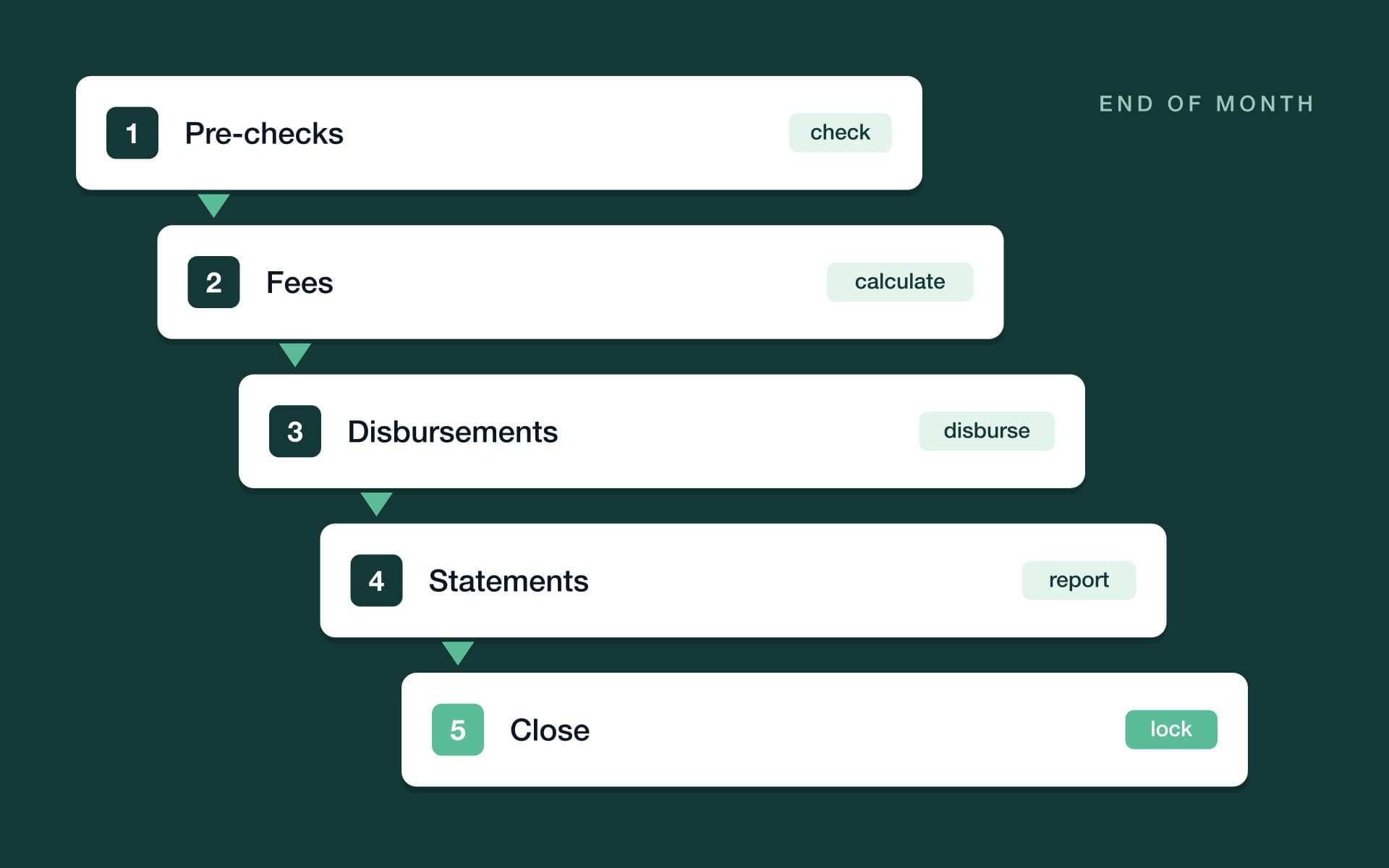
End of month — EOM — is where the whole system proves out. It's the monthly close of end of month property management: the period is checked, fees are calculated and taken, owners are paid, statements go out, and the books are locked. In folklore, EOM is a dreaded multi-day slog. In practice its size is set entirely by the daily loops that preceded it: if receipting, allocation and reconciliation are current, the close is a sequence of confirmations. If they aren't, EOM is where all the deferred work comes due at once.
Pre-EOM checks
Before anything moves, confirm the period is actually ready to close. Every deposit receipted and every bundled payout split. Unallocated funds at zero. The three-way reconciliation current as of the last banking day. Pending contractor bills either processed or deliberately held to next month — decided, not forgotten. Failed or bounced guest payments chased, or reflected in the ledger picture so no owner is paid on money that never arrived. The pre-EOM pass isn't busywork; every check here is a mis-payout prevented later in the run.
Fee calculation
Calculate what you've earned — per the agreement, per ledger. Management fees on the stays that completed in the period, your share of upsells, and any charges the agreement lets you pass through. Check the output against the agreements rather than against habit, because fee errors are awkward in both directions: undercharge and you quietly fund your owners; overcharge and an owner's accountant will eventually find it, at the worst possible moment. Once verified, earned fees transfer from trust to operating as a documented movement — never a round-number sweep.
Owner disbursements and payouts
Now pay the people the money belongs to. The disbursement run pulls from each owner's ledger: the period's income, minus expenses paid, minus fees, minus any float the agreement holds back for upcoming bills. Every payout should trace line by line to the ledger it came from — if a number in the run surprises you, stop and trace it before paying, not after. This is also the point to settle any contractor bills queued for the cycle, so the period each owner sees is settled, not still moving.
Statements out
Every disbursement travels with a statement — the owner's view of the same ledger you just paid from. Send them together: a payout that arrives without its explanation generates the exact email you were trying to avoid. What makes a statement good is its own topic, covered below; at EOM the operational rule is simply that no payout ships without one.
Close and archive
Lock the period, then archive the artifacts that prove it: the final three-way reconciliation, each ledger's closing balance, the cashbook for the period, a copy of every statement, and the remittance records for bills paid. Locking matters more than it seems — a period that can be silently edited after statements have gone out isn't closed, it's just quiet. Next month starts from balances you can point to.
| Step | What it protects the owner from | The output |
|---|---|---|
| Pre-EOM checks | Being paid from an incomplete or unbalanced period | A receipted, allocated, reconciled period ready to close |
| Fee calculation | Fees that drift from what the agreement says | Earned fees documented and transferred to operating |
| Disbursements and payouts | Late, short or unexplainable payouts | Owners and contractors paid from the right ledgers |
| Statements out | A payout they can't decode | A statement per owner, attached to the payout |
| Close and archive | Books that change after the fact | A locked period with its records archived |
The measure of a good EOM is that it's boring. Owners are paid on the schedule the agreement promised, the statements match the payouts, and nothing in the run needed a judgment call — because the judgment calls were all made earlier, one day at a time, when they were small. If your close still produces surprises, the fix is almost never a better closing checklist; it's a tighter daily loop.
Owner statements that answer their own questions
The statement is the product owners judge you on. Most owner questions — where did this charge come from, why is this month lower, was the plumber actually paid — are really statement questions: the document either answers them before they're asked, or it generates them. A good owner statement reads like an account of stewardship, not an accounting artifact, and it's one of the strongest retention tools a manager has. An owner who understands every line has no reason to wonder what's happening to their money; an owner who doesn't will eventually wonder out loud.
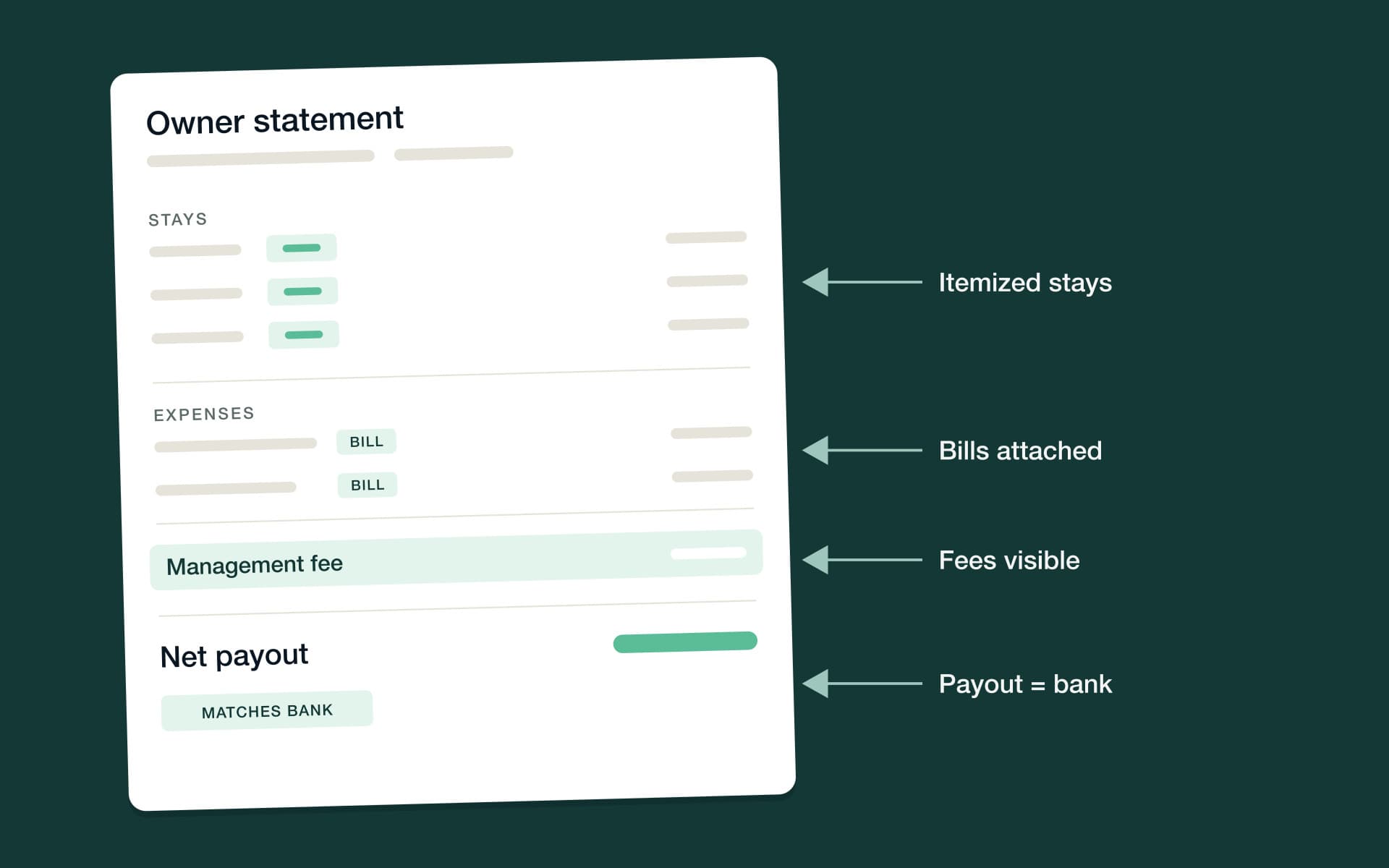
A statement that answers its own questions shows:
- The property and the period, unambiguous at the top.
- Every stay, itemized — dates, source and what it earned, not a single rental-income lump.
- Every expense with its bill attached — a line that says what was fixed, and the contractor's invoice behind it.
- Fees on their own lines — management commission and upsell shares visible, never netted invisibly into income.
- Any float carried, stated as a balance held for upcoming bills rather than silently absorbed.
- A net payout that matches the bank transfer — to the dollar, on the date.
Then go one step further than a monthly document: give owners a place to look things up themselves. A self-serve owner portal that shows statements, payouts and documents on demand turns the month-end question flood into self-service — the owner checking a line finds the bill attached to it, and the email never gets written. Transparency, it turns out, is mostly a formatting decision.
Staying audit-ready
Audit-ready is a state, not an event. Whether your books face a formal trust audit, an owner's accountant, or just a hard question long after the fact, the test is the same: can you produce, for any transaction in the trust, the story of where it came from, whose it was and where it went — without reconstruction? Requirements vary by jurisdiction — confirm what applies to your operation with your local regulator — but the record-keeping that satisfies nearly any standard is the same set of habits:
- Reconciliation reports retained as they were run — a dated trail showing the trust balanced continuously, not just recently.
- Source documents attached at the transaction: the reservation behind every receipt, the invoice behind every bill, the remittance advice behind every payment run.
- Statements and disbursement records kept per owner, matching the payouts the bank shows.
- Management agreements on file and current, since they're the authority for every fee taken.
- A locked history — closed periods that can't be silently edited.
This is also the honest standard to hold software to. Trust accounting in PropertyStack, for example, is built to be reconciled and audit-ready to your jurisdiction's standard — the reconciliation trail, the attached documents and the locked periods are the product expression of exactly this list.
What should you look for in trust accounting software?
Generic accounting tools assume every dollar in the file is yours — one entity, one owner, one profit line. Trust accounting inverts that assumption, which is why running client money through general-purpose bookkeeping usually ends in shadow spreadsheets doing the real work. When you evaluate trust accounting software, four capabilities separate purpose-built from adapted:
- Per-owner ledgers as a first-class concept. Real ledgers with balances the system defends — so "whose money is this" is a field on every transaction, not a category you filter by and hope.
- A built-in three-way reconciliation view. Bank, cashbook and ledgers on one screen, kept current by the daily workflow — not a report you assemble from exports at month end.
- Disbursement runs with statements attached. End of month as a run the system executes — payouts pulled from ledgers, statements generated and sent with them — rather than a checklist you re-improvise monthly.
- Automated payment collection feeding the trust. Guest charges collected on schedule and receipted against the right reservation from the moment they land, so allocation starts correct instead of getting corrected.
Then ask one more question of any vendor: where does the money physically sit, and how does the platform prove your ledgers match it? A confident answer describes reconciliation. A vague answer describes a dashboard.
How PropertyStack runs trust accounting
PropertyStack, an agentic property management platform for short-term rentals, treats the loop in this guide as the product itself. Daily trust tasks keep the three-way balance current. The reconciliation page puts bank, cashbook and ledger side by side. Bills flow through a billing inbox with bulk payment and remittance built in. And end of month runs as a prepared sequence — preparation checks first, then the EOM run handling dispersals and payouts, with statements generated for every owner.
The AI accounting agent does the repetitive work inside guardrails you set: it reconciles bank lines as they arrive, pulls contractor bills from the portal into payables, generates and sends owner statements, and answers owner questions in the portal. Approval thresholds decide what runs automatically and what waits for your sign-off — the agent does the matching and the drafting, and a human signs the money movements that matter. For property managers running portfolios on behalf of multiple owners, that's the difference between trust accounting as a back-office department and trust accounting as a background process.
Frequently asked questions
The short version, for the questions operators ask most.
Daily is the working standard for active portfolios. Reconciliation frequency determines how hard breaks are to find: on a daily cadence, any discrepancy is at most one day deep. Some jurisdictions also mandate a minimum frequency — requirements vary, so confirm with your local regulator.
End of month (EOM) is the monthly close of a manager's trust accounts: the period is checked and reconciled, fees are calculated and taken, owners are disbursed their net income, statements are sent, and the period is locked so the records can't silently change.
Receipt the payout the day it lands, then split it across the reservations it covers — each stay's income to its owner's ledger, cleaning fees and add-ons routed per your agreements, and your commission portion identified. A bundled deposit shouldn't sit unallocated overnight.
Only once they're earned, as your management agreement defines, and as a documented transfer identifying the stays and fees behind it — not an ad-hoc or round-number sweep. The rules on timing and method vary by jurisdiction, so confirm with your local regulator.
The property and period, every stay itemized with what it earned, every expense with its bill attached, fees on their own visible lines, any float carried, and a net payout matching the bank transfer. A good statement answers owner questions before they're asked.
Trust accounting in PropertyStack is built to be reconciled and audit-ready to your jurisdiction's standard. Daily trust tasks keep the three-way balance current, the reconciliation page shows bank, cashbook and ledger side by side, and end-of-month runs handle dispersals, payouts and owner statements.
Still have questions?
Ask PropertyStack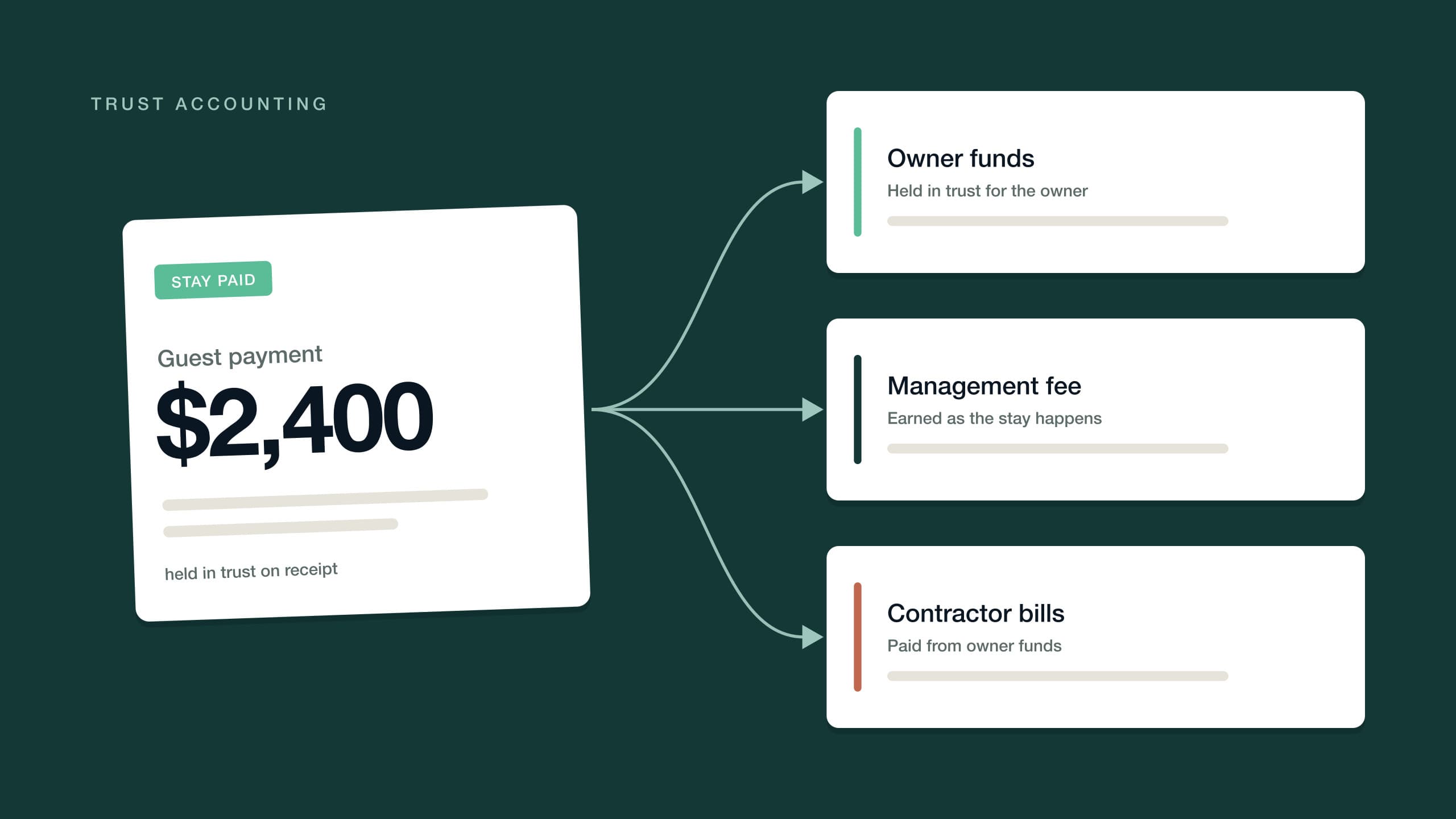

See it on your own listing. Free, from one link.
Paste an Airbnb listing and we'll show you what it could look like — a rewritten title, description, photos and a task list from your reviews.
- Syncs with every channel
- Cancel anytime
- AI agents with Pro