Trust account rules for holiday rentals in New South Wales
What NSW Fair Trading asks of agents who manage short-term rentals for owners: the licence, the account, who can sign, the 30 September audit and the short-term rental code. Each rule linked to its source.

Written by Joshua Freeman
Co-Founder, PropertyStack · · 11 min read
Contents
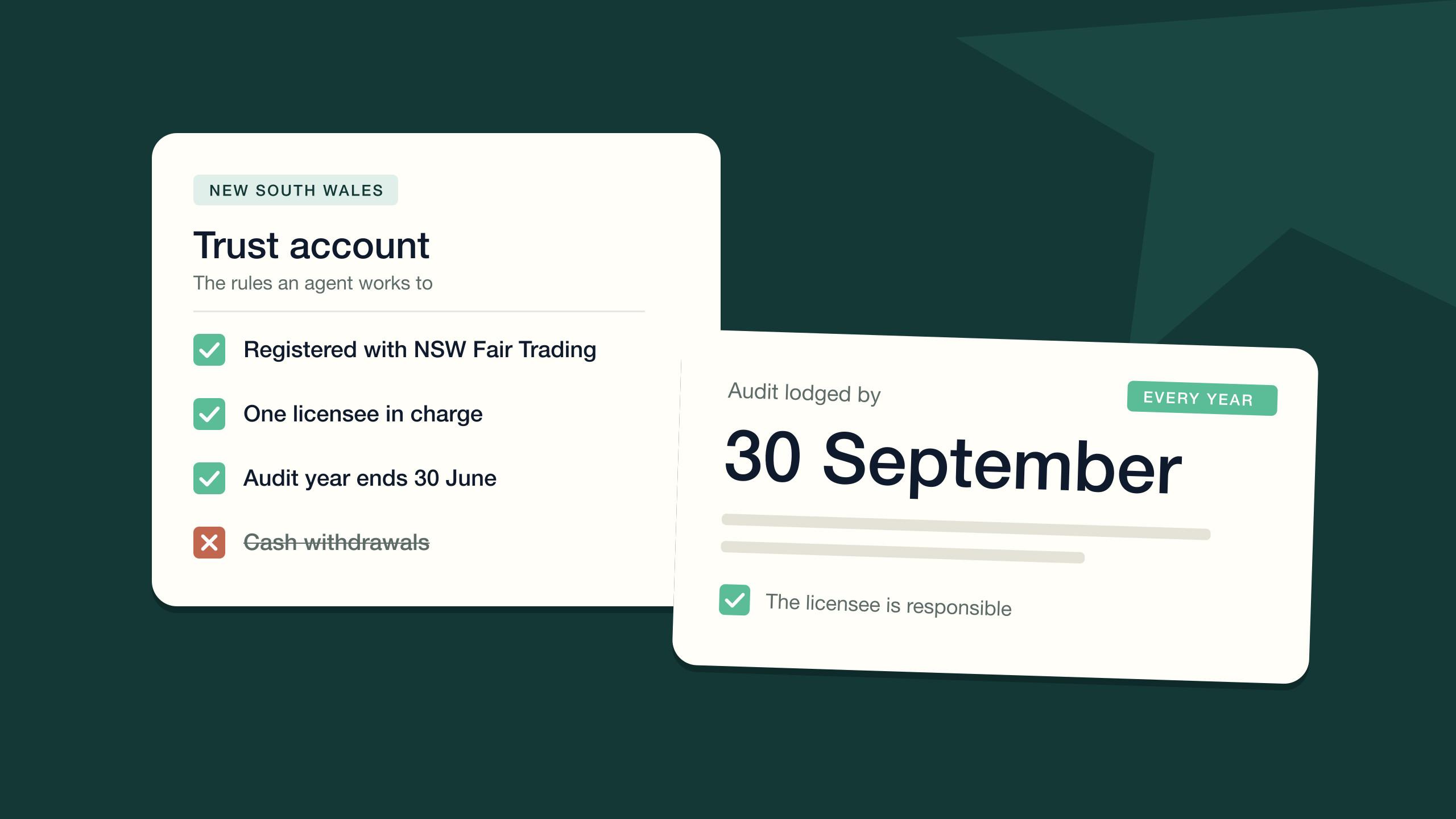
Lodge your trust account audit a day late in New South Wales and two things happen. NSW Fair Trading can fine you. And, in its own words, missing the date "makes an individual or corporation a disqualified person under the Act and liable to disciplinary action". The date is 30 September, every year. It does not move.
This guide sets out what NSW asks of anyone who manages holiday rentals for owners and handles their money, with a link to the government page behind each rule. If you would sooner hand the daily work to a team, see our trust accounting service for short-term rental managers. The duties below stay with you either way.
Is money from a short-term rental trust money in NSW?
Yes, when an agent handles it. NSW Fair Trading's property management page says: "payments for a short-term rental accommodation arrangement, including any deposits, are regarded as trust money and must be handled in accordance with the Property and Stock Agents Act 2002".
The same page sets three expectations for agents who manage short-term stays:
- Money received is paid into the agent's trust account "as soon as practicable".
- A trust account receipt is issued to the guest for any money received.
- The owner should give written instructions on how the money is to be paid out.
It also notes that short-term stays last up to 3 months, sit outside residential tenancy law, and need a written agency agreement between you and the owner. There is no requirement for a bond on a short-term stay, though a security deposit can be agreed, according to the short-term rental accommodation page.
Who needs a licence to manage holiday rentals in NSW?
The government's wording is careful here, and worth reading exactly. The short-term rental accommodation page says no licence is needed to host, but "if a person acts as an agent for arranging stays, then they may need to be licensed as a real estate agent in NSW". Note the word "may". Whether your business needs a licence depends on what you do for owners, and it is a question to put to NSW Fair Trading directly.
What is clear from the real estate agent licence page: you need a real estate agent licence "to sell, lease and manage real estate on behalf of clients". And the class of licence matters for trust money. "Class 2 licence holders are not allowed to open or manage a trust account, or be nominated as a licensee in charge of a business."
How do you set up a trust account in NSW?
The rules are on NSW Fair Trading's page on real estate trust accounts and audit requirements. It opens with the principle: licensees "must hold clients' funds in a trust account". Then the set-up:
- Use an approved bank in NSW. The account must be at an authorised deposit-taking institution in NSW that the Secretary has approved. The page lists them.
- Name it correctly. The words "Trust Account" must be in the account name and on every cheque. You tell the bank in writing that it is a trust account required by the Act.
- Register it. Each trust account is registered with NSW Fair Trading, which issues a unique identifying number that you give to the bank. Each account is registered separately, online.
- Close it properly. Within 14 days of closing a trust account, you notify NSW Fair Trading.
If you hold a licence from another state and work in NSW under automatic mutual recognition, the page says you cannot use the online portal. You email NSW Fair Trading for the number.
Who can take money out of the trust account?
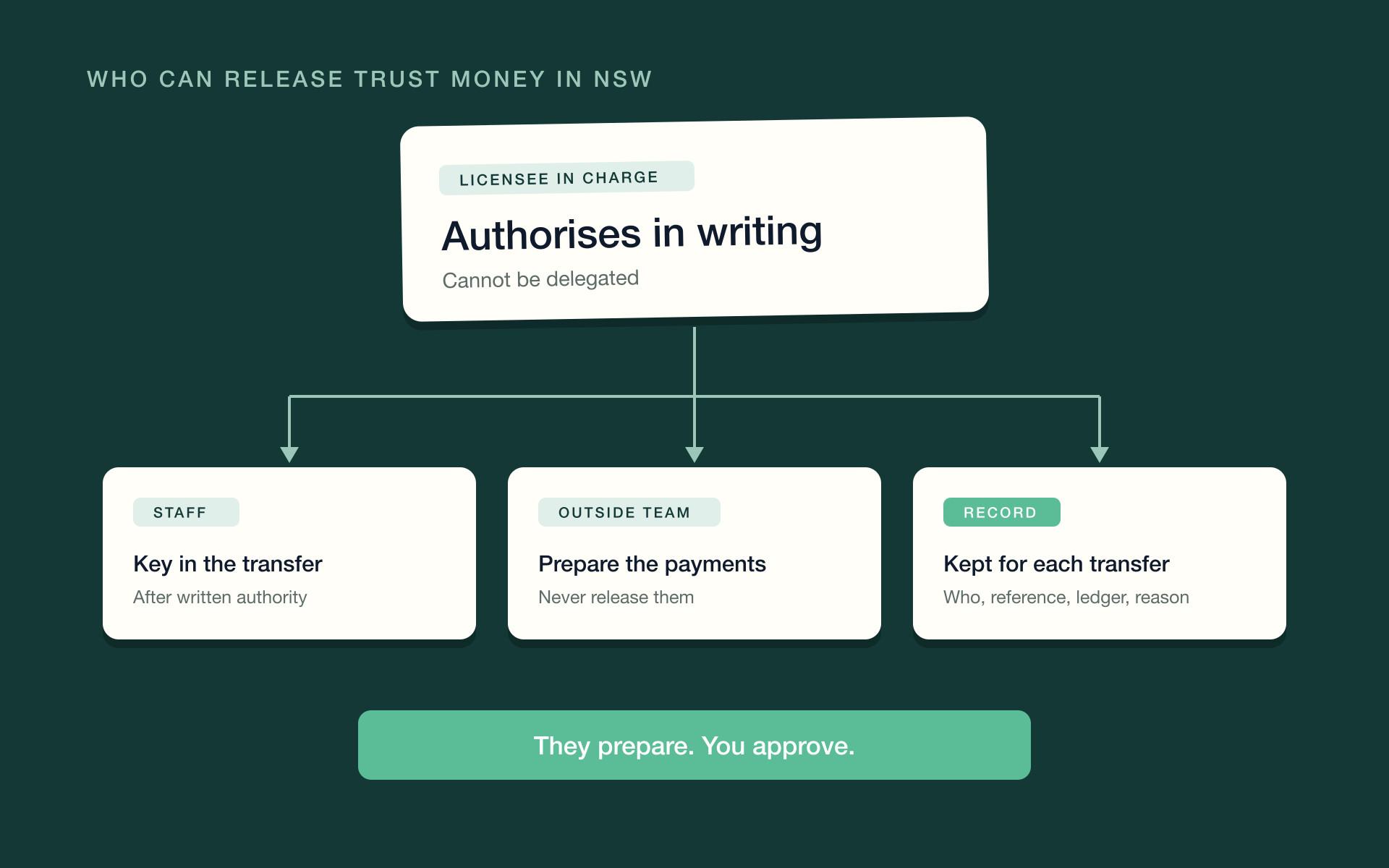
One person. Each trust account has one licensee in charge, and the trust accounts page is direct about it: the licensee in charge "is unable to delegate their authority to another person".
The licensee in charge page adds the working rules. "Cash withdrawals are prohibited." Money leaves by cheque or electronic transfer. A staff member can key in a transfer, but only after the licensee in charge has authorised it in writing. For each transfer, a record is kept of who made it, a reference, the ledger accounts it was drawn from and the reason.
And the money has one purpose. Funds held for a client "cannot be used for any purpose other than for that client and must be disbursed as the client directs".
What has to happen each day and each month?
NSW Fair Trading's supervision guidelines set out what an agency's own procedures must cover. Two apply directly to the trust account:
- "daily or next day banking practices for trust moneys"
- "a procedure for the monthly review of trust accounts, which includes ensuring that any adjustments shown at the end of month reconciliation can be explained with evidence"
Read that second one again. It is not enough for the month to balance. Every adjustment on the reconciliation needs evidence behind it. That is the part that takes the time at 50 or 100 properties: a channel payout that covers six stays across four owners, a refund that reverses money already allocated, a cleaning invoice entered against the wrong property.
Operators feel it. One told us that "end of months is our busiest time". If you want the method that fixes it, our guide to trust accounting for short-term rentals covers the month step by step.
When is the NSW trust account audit due?
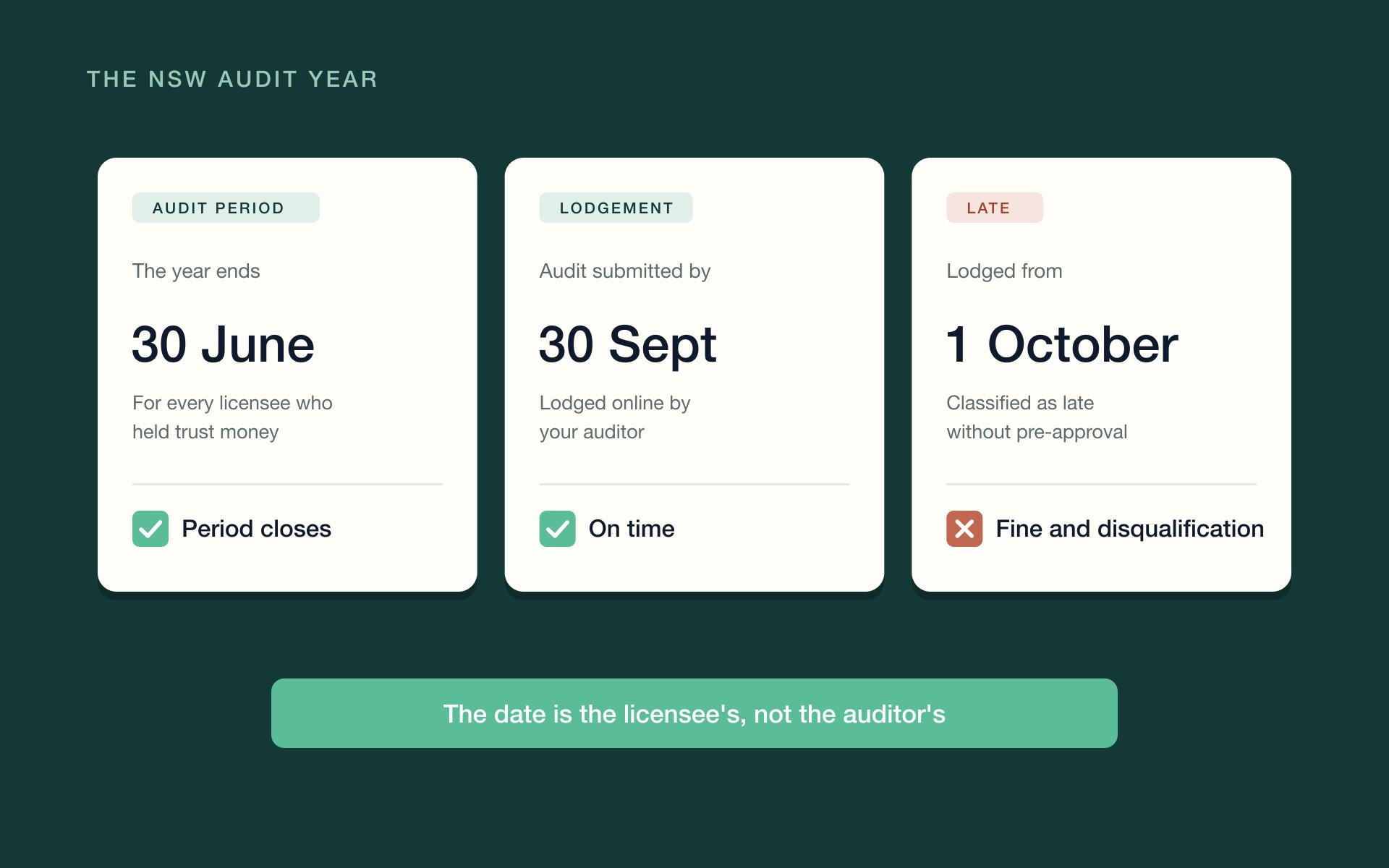
The trust accounts page gives the dates in one sentence: "The 'audit period' is the year ending on 30 June and the audit must be submitted by 30 September."
- Who needs one: licensees who received or held trust money during the audit period. Former licensees too.
- Who lodges: the auditor lodges online, once you have authorised them. But the page is clear that "it's the licensee's responsibility to ensure the report is lodged by the due date".
- Who can audit: an auditor qualified under section 115 of the Act. The page names registered audit companies, authorised company auditors and members of a professional accounting body who hold a public practice certificate.
- Who cannot: anyone who has been your employee or partner in the last 2 years, or who is a licensee.
- If the account sat empty: with no transactions and a zero balance, you email NSW Fair Trading a copy of the bank statement for the full audit period.
Late is late. NSW Fair Trading's page on lodging audits says audits submitted from 1 October to 31 December "are classified as late, except with pre-approval". Extensions are for exceptional circumstances, with evidence.
What are the penalties?
From the same government pages, as shown in November 2026:
- A late audit: NSW Fair Trading "could issue a $550 fine for a late lodged audit by an individual or $1,100 for a corporation".
- A late audit also makes you a disqualified person under the Act, which can stop a licence renewal.
- Unclaimed trust money: failing to make reasonable efforts to find the owner "could attract a penalty of up to $5,500".
Misuse is a different order of trouble. In July 2026 NSW Fair Trading reported that an agent had been sentenced for fraudulently obtaining $539,000 from a company trust account. In August 2026 it disqualified a former property manager for 10 years after more than $180,000 was taken from rental trust and bond accounts, including 162 fraudulent transactions.
The short-term rental code sits on top
Separate to trust money, NSW has a code of conduct for the short-term rental industry. The government says compliance "is mandatory for all participants of the short-term rental accommodation industry where the residential premises is in NSW". Under the page on letting agent and facilitator obligations:
- A letting agent must not advertise a property unless it is on the short-term rental premises register and its registration number is displayed.
- A letting agent must not advertise or offer accommodation for a host or premises listed on the exclusion register, and must keep a listed guest from using its services.
- "Letting agents must keep records of each transaction entered into using its services for 3 years."
The host registers the property through the NSW Planning Portal before it is advertised. As the letting agent, you cannot advertise it without that number.
A NSW trust accounting calendar
Every business day
- Bank trust money the same day or the next.
- Issue a trust account receipt to the guest.
- Match each bank line to a booking, an owner or a bill.
Every month
- Reconcile, and file the evidence for every adjustment.
- Have the licensee in charge authorise payments in writing.
- Send each owner their statement.
Every year
- 30 June: the audit period ends.
- July and August: get the records to your auditor.
- 30 September: the audit is lodged.
Do it yourself, or hand the legwork over?
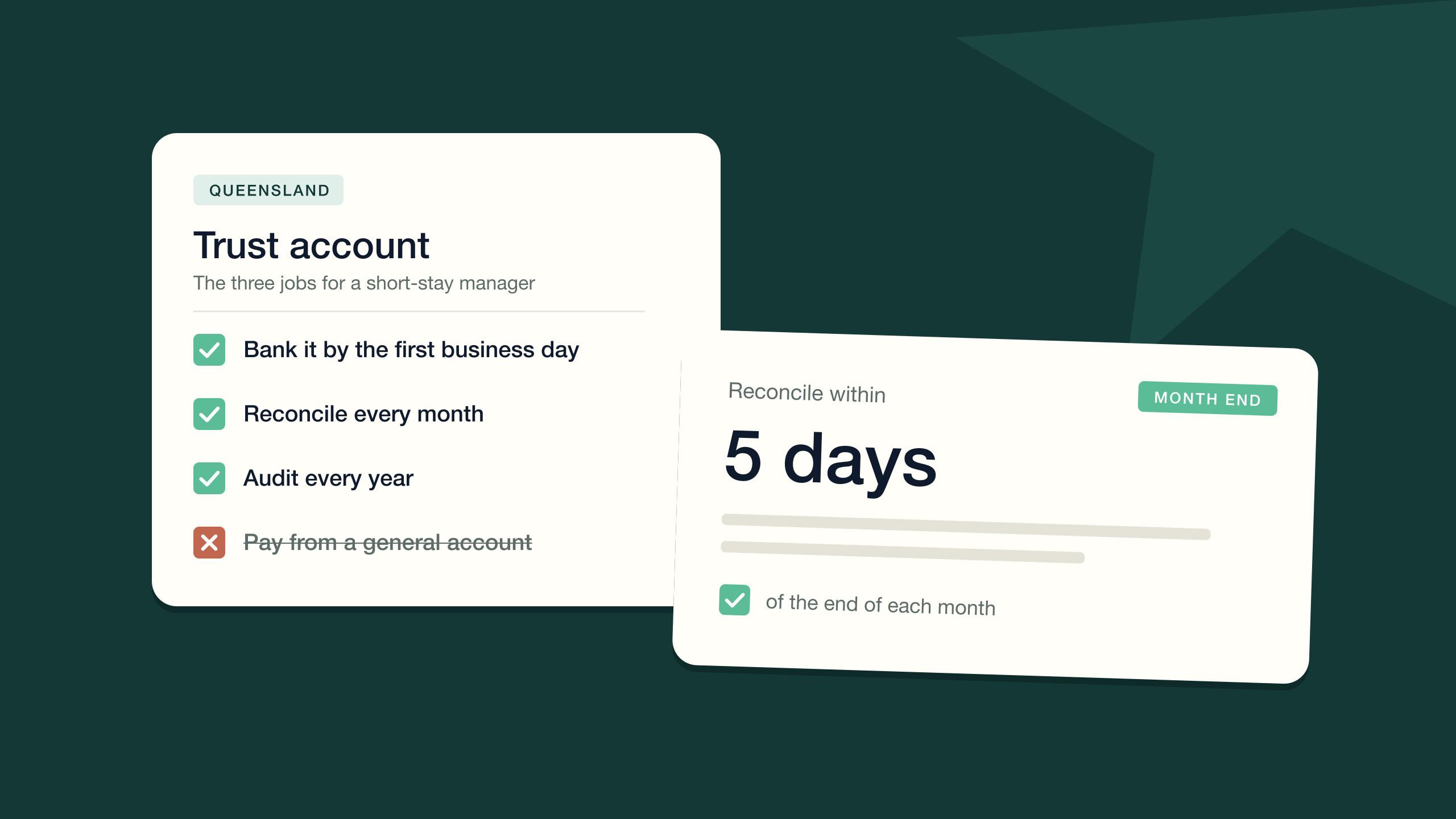
Managing across the border as well? The Queensland rules differ on banking deadlines, audit dates and auditor appointment. We cover them in trust account rules for short-term rentals in Queensland.
As for how to get the work done, there are three routes: by hand with a bookkeeper, with trust accounting software you run yourself, or with a team that does the daily work while you keep the approvals. We ran the trust account for our own short-stay business, Urban Shore, as it grew to 380+ properties, and built the third route from that. Our team reconciles every business day, enters the bills and prepares end of month. You review it and authorise the payments. That takes 98% of the finance work off your desk, and it works with the booking software you already use.
The licence, the account and the sign-off stay with you, as NSW requires. If you would like to hear how it runs from another operator, ask us for a reference call with a current customer.
Frequently asked questions
The short version, for the questions operators ask most.
When an agent handles it for an owner, yes. NSW Fair Trading says payments for a short-term rental accommodation arrangement, including any deposits, are regarded as trust money and must be handled under the Property and Stock Agents Act 2002.
By 30 September each year, for the audit period ending 30 June. Audits lodged from 1 October to 31 December are treated as late unless NSW Fair Trading has approved an extension beforehand.
Only the licensee in charge. Each trust account has one, and NSW Fair Trading says that authority cannot be delegated. Staff can key in an electronic transfer only after the licensee in charge has authorised it in writing.
NSW says a person who acts as an agent for arranging stays may need to be licensed as a real estate agent. It depends on what you do for owners. Ask NSW Fair Trading about your own business before you rely on any general guide.
NSW Fair Trading can issue a fine, and a late audit makes the individual or corporation a disqualified person under the Act, liable to disciplinary action. That can affect a licence renewal. The licensee is responsible for the date, not the auditor.
Still have questions?
Ask PropertyStackKeep reading
Money & accounting
Trust account rules for short-term rentals in Queensland
· 11 min read
 Joshua Freeman
Money & accounting
Trust accounting for short-term rentals in Australia: software and done-for-you options compared
· 12 min read
Joshua Freeman
Money & accounting
Can you keep your PMS and hand off the trust accounting?
· 10 min read
Joshua FreemanSee it on your own listing. Free, from one link.
Paste an Airbnb listing and we'll show you what it could look like — a rewritten title, description, photos and a task list from your reviews.
- Syncs with every channel
- Cancel anytime
- AI agents with Pro