Trust account rules for short-term rentals in Queensland
What the Office of Fair Trading asks of anyone who manages holiday rentals for owners: the licence, the account, the daily and monthly jobs, and the audit. Each rule linked to its source.

Written by Joshua Freeman
Co-Founder, PropertyStack · · 11 min read
Contents
In May 2026 a Queensland court ordered a Mount Tamborine operator to pay almost $24,000. She had managed one owner's property on Airbnb, Stayz and Booking.com for about five months, without a real estate licence. The Department of Justice published the outcome and the Fair Trading Commissioner spelled out what the owner had missed out on: a criminal history check, training and, in his words, "most importantly, the requirement to keep rental monies in a trust account".
So the regulator is watching short-stay. If you manage holiday rentals for owners in Queensland, this guide sets out what the rules ask of you, in plain words, with a link to the government page behind each one. If you would sooner hand the day-to-day work to someone else, that is what our trust accounting service for short-term rental managers does. Either way, the duties below stay yours.
Who needs a licence to manage short-term rentals in Queensland?
Anyone who does it for an owner, for reward. The Department of Justice puts it this way in the court outcome: "Anyone managing rentals on behalf of owners, including through short-term letting platforms such as Airbnb, Stayz or Booking.com, requires a real estate licence." An owner can list their own place without one. The moment you negotiate the letting or collect the rent for someone else, you must be licensed under the Property Occupations Act 2014.
Queensland has two licences that matter here. A real estate agent licence covers renting property and collecting rent for owners. A resident letting agent licence covers letting units inside a building complex, on behalf of the owners and the body corporate, and needs body corporate approval for each complex.
The court case shows what happens without one. The operator was fined $5,000, ordered to repay $9,594.70 in letting fees and expenses, and to pay $9,250 in court costs. She had been paid more than $4,000 for the work.
When do you need a trust account?
As soon as you hold money for someone else. The Office of Fair Trading's page on opening a trust account says: "You must have a trust account in order to handle money on behalf of another person." The steps are set out on the same page:
- Get the licence first. You must hold your licence before you open the account. Only the principal licensee can operate it.
- Use an approved bank, at a Queensland branch. The page lists the approved financial institutions.
- Name it properly. The account name must contain the words "trust account".
- Tell the Office of Fair Trading. You notify them that the account is open, on their form, within 2 months. The same goes for closing or renaming it.
- Appoint an auditor. Within 1 month of opening the account, then send evidence that the auditor has accepted within 1 more month. That rule is on the audits page.
What counts as trust money in holiday letting?
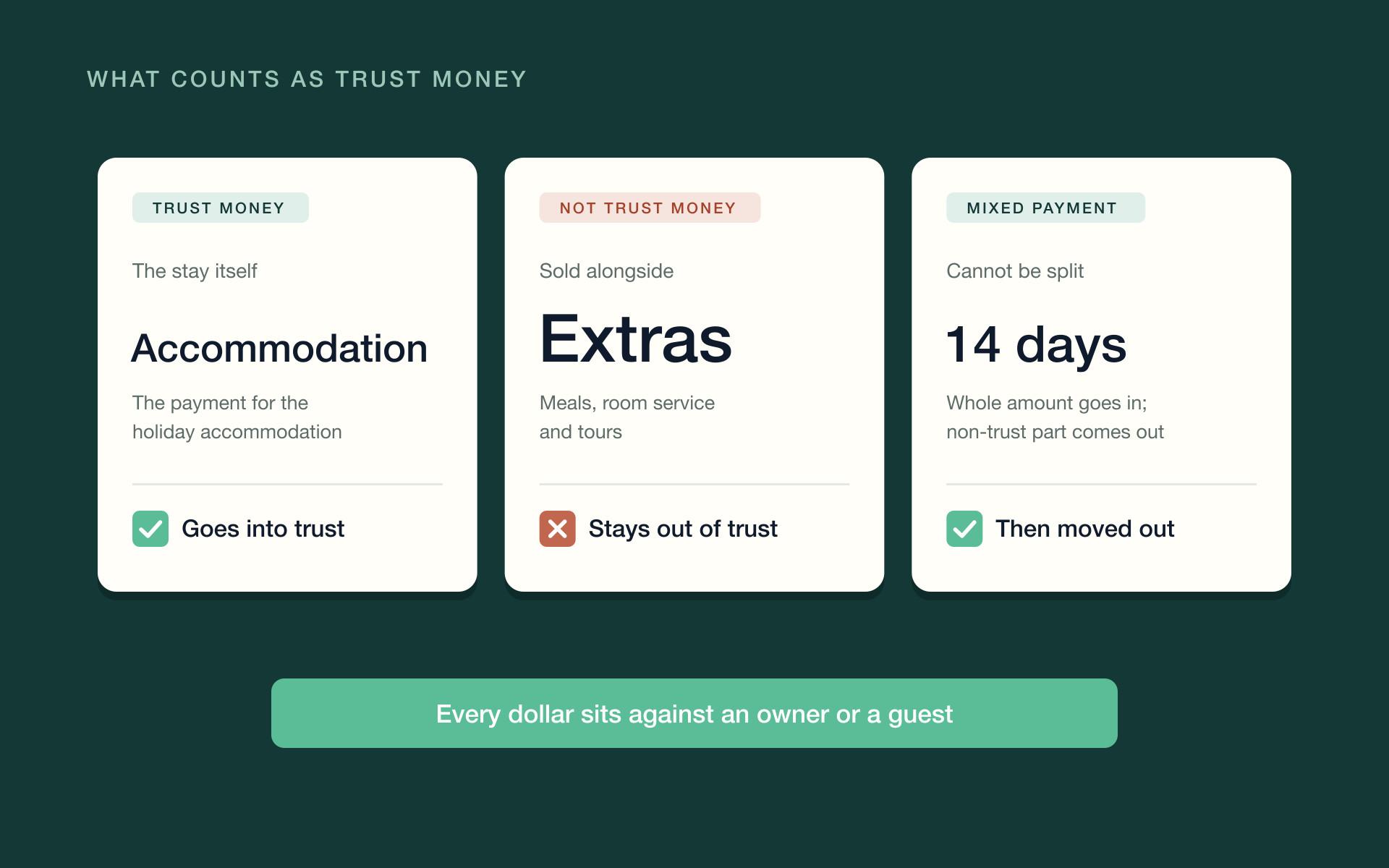
This is where short-stay differs from a standard rent roll, and the Office of Fair Trading covers it directly on its page about trust and non-trust money. The accommodation payment is trust money. Extras you sell alongside it are not. The page's own example: "Payment for the holiday accommodation is trust money, but the meals, room service and tour are not."
- A mixed payment you cannot split goes into trust in full. The non-trust part must come out within 14 days of the money becoming available.
- A deposit for a stay not yet allocated to a unit can stay in trust until the unit is allocated and that owner becomes entitled to it.
- Every dollar needs a home. Any amount deposited must sit against a ledger for an owner or a guest.
- Leaseback is different. If you lease the property from the owner and sub-let it to guests, the money you receive is not trust money, though the page says money received for an owner you have promised a fixed rental return may still be.
One gap to know about. The government pages do not say how to treat a booking platform payout that lands days after the stay, with the platform's fee already taken out. They cover money you receive. How you receipt a bundled Airbnb or Booking.com payout across several owners is a question for your auditor, and worth settling in writing before your next audit.
The daily jobs: banking and receipts
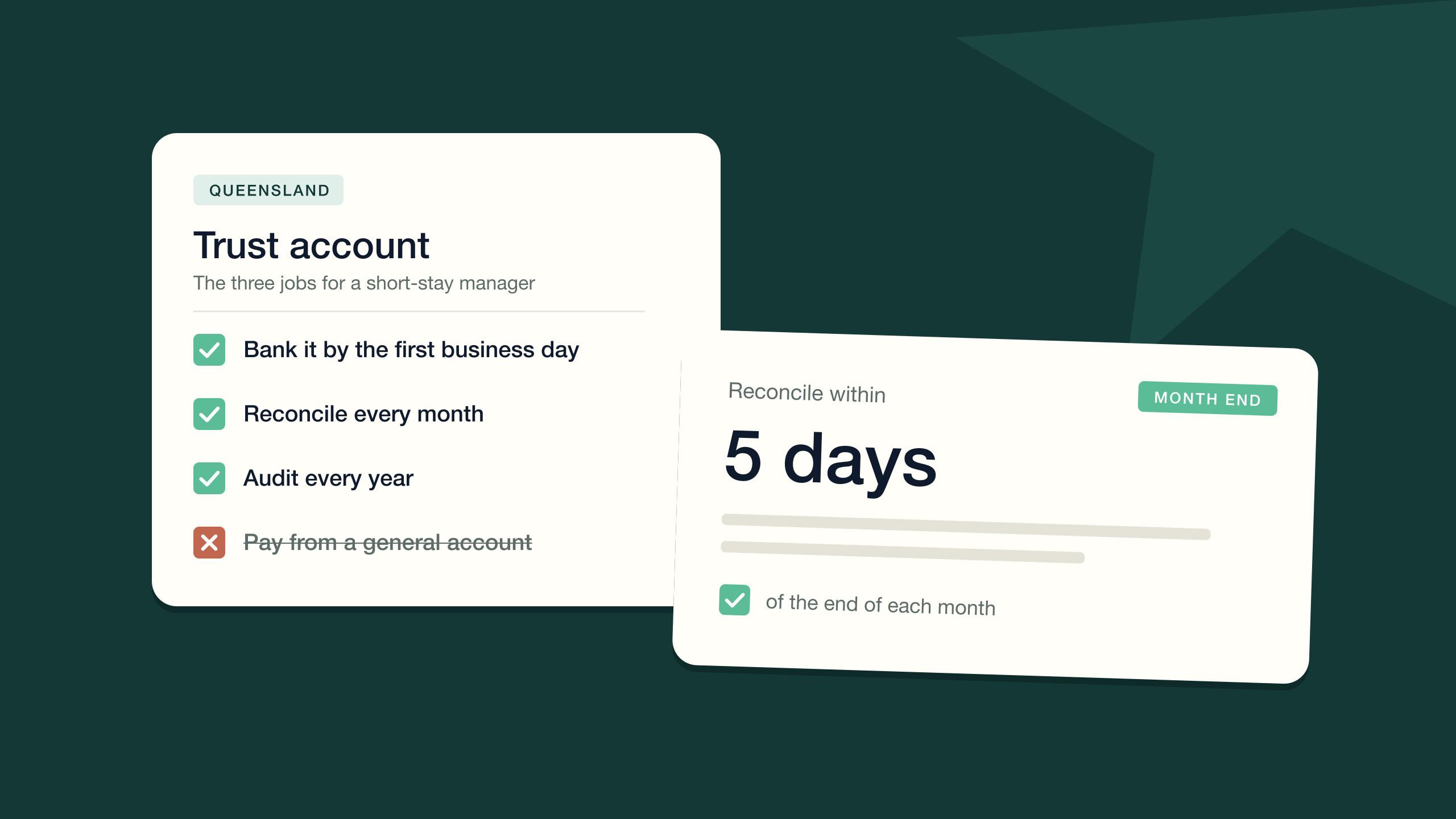
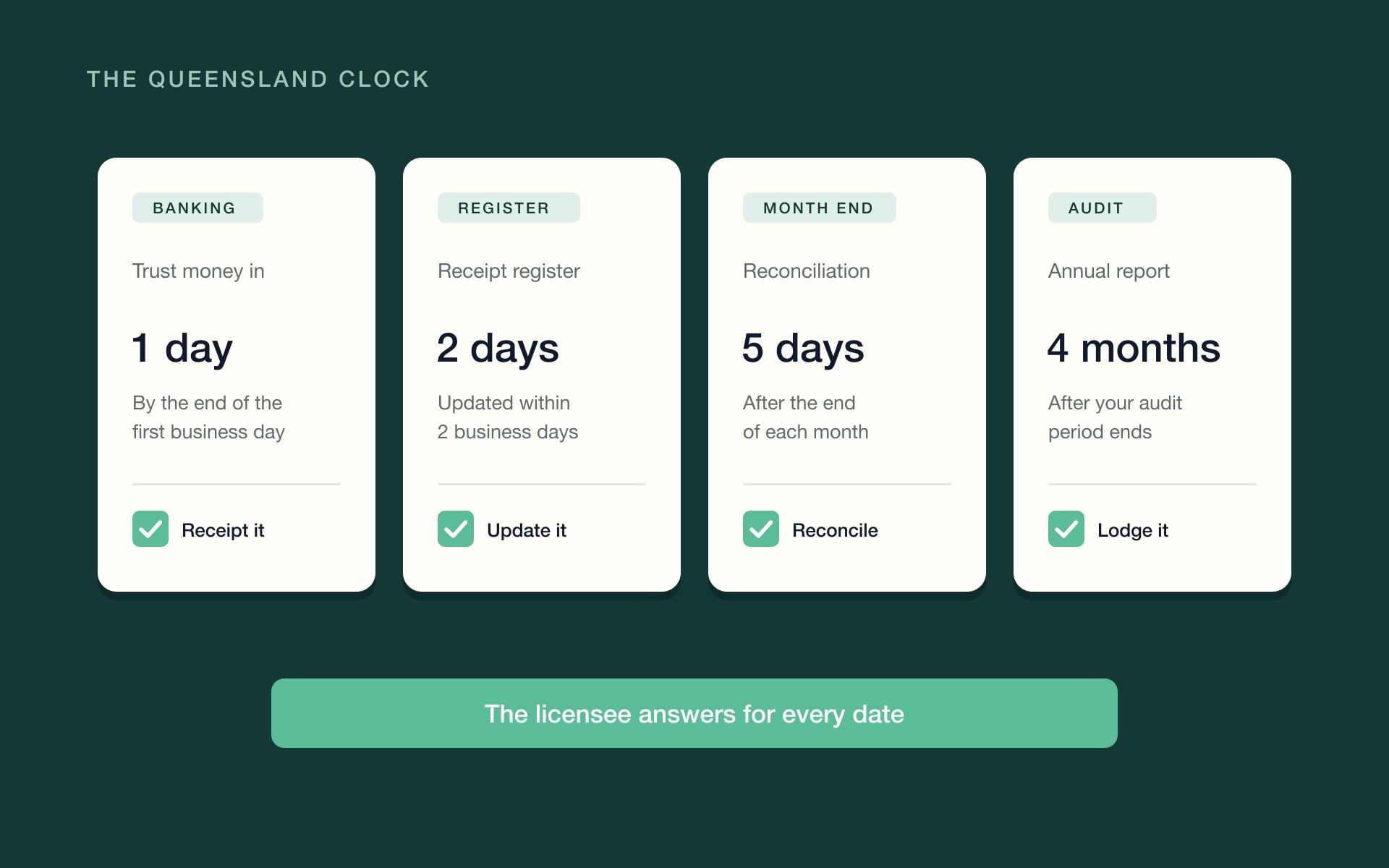
The handling trust money page sets the clock. When trust money comes in, you complete a receipt and "make sure it is banked into your trust account before the end of the first business day".
- Receipts are numbered in order and carry the title "Agents Financial Administration Act 2014 – Trust Account Receipt", with your licence number, the date, who paid, how much and how.
- The receipt register is updated within 2 business days.
- Payments out go straight from the trust account. The page is blunt: "It is illegal to transfer money to recipients via a general account."
- Electronic payments need a transaction report from your bank, kept on file, plus a record of the amount and the account it went to.
- Withdrawals need the client's written authority: to pay authorised expenses, to pay the owner their share, and to take your fees as the appointment sets out.
If you keep the books on a computer, the same page has rules for the system. It must not allow a ledger account to be deleted, it must record changes, and it must be backed up at least once a month and kept at separate premises. Records are kept for 5 years.
The monthly job: reconciliation
Once a month, three records have to agree. The Office of Fair Trading requires you to reconcile your trust account book with your trust ledgers and a bank statement at the end of each month, and its handling trust money page gives you 5 days after month end to do it.
With a handful of properties this is an hour's work. With 60, it is the week managers dread. One manager with about 35 properties told us, "Sometimes I'm late because I just don't get to the statements." The rule does not get harder as you grow. The volume does.
Owners feel the result. You must give each client a written account within 42 days of a transaction being finalised, or within 14 days if they ask in writing. In practice that is the monthly owner statement. If reconciliation runs late, statements run late, and owners start ringing. If you want the working method, our guide to trust accounting for short-term rentals walks through the month step by step.
The yearly job: the audit
"Each trust account must be audited every year by a qualified auditor and you must lodge the annual audit report with us." That is the opening line of the trust account audits page. The details that catch people out:
- Your audit period depends on the month your licence was issued. The page has a table of audit periods by month. Find your own row before you book the auditor.
- The report is due 4 months after the audit period ends. In your last year of business, 2 months after you stop trading.
- You are responsible for lodging on time, not the auditor. An extension has to be requested in writing before the due date.
- Who can audit: a person registered as an auditor under the Corporations Act 2001, or a member of CPA Australia, Chartered Accountants or the Institute of Public Accountants at the levels the page lists.
- If the account was not used at all in the period, you can lodge a statutory declaration in place of an audit report.
- If you change auditor, you and the auditor each email the Office of Fair Trading the reasons within 1 month.
What happens if you get it wrong?
The penalties are on the government's own pages. For misuse of trust money, the trust and non-trust money page states: "up to a $34,540 fine or 2 years imprisonment" (the figure shown in November 2026). For a late audit, the Office of Fair Trading says it can fine you, and "we can cancel or suspend your licence".
The Office of Fair Trading's court outcomes register shows these are used. In 2025 one agency was fined for failing to lodge an audit report. Another agent received a suspended prison sentence for wrongly converting trust money. And in 2026, the short-term letting case that opened this guide.
A month of Queensland trust accounting, as a checklist
Every business day
- Receipt every amount of trust money received.
- Bank it by the end of the first business day.
- Match each bank line to a booking, an owner or a bill.
- Pay from the trust account only, with written authority on file.
Every month
- Reconcile the trust account book, the ledgers and the bank statement within 5 days of month end.
- Move any non-trust money out within 14 days of it becoming available.
- Send each owner their statement.
- Back up your records and keep the copy somewhere else.
Every year
- Give your auditor the records in good time.
- Check the report is lodged within 4 months of your audit period ending.
Do it yourself, or hand it over?
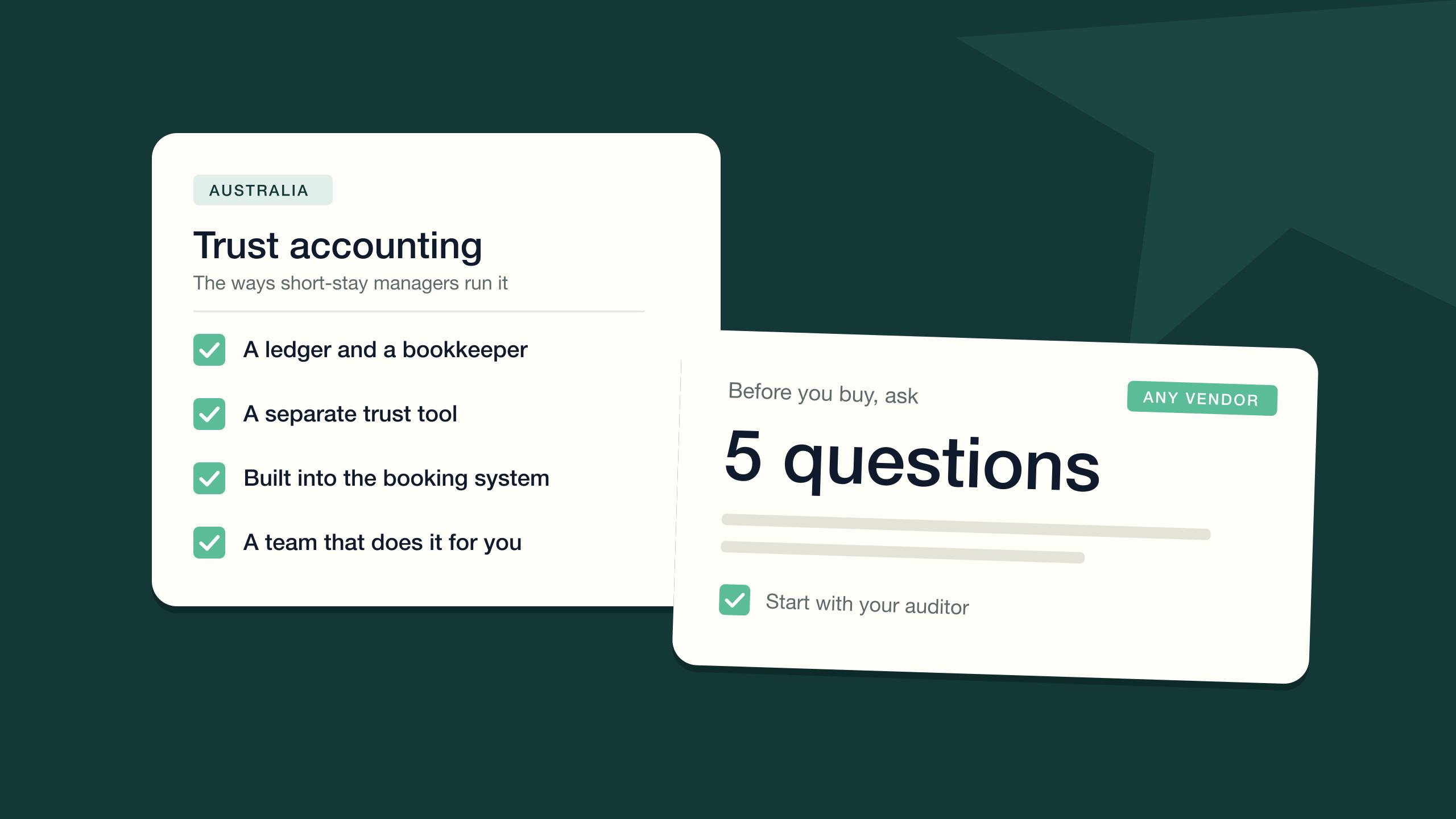
You have three honest choices. Keep doing it by hand, with a bookkeeper and spreadsheets. Buy trust accounting software and run it yourself. Or keep the licence and the approvals, and have a team do the legwork. We compare the software and the services available to Australian managers, by name, in trust accounting options compared.
We built the third choice because we needed it ourselves. Before we sold software, we ran the trust account for our own short-stay business, Urban Shore, as it grew to 380+ properties. Our team reconciles your bank feed every business day, enters the bills and prepares end of month. You review it and press pay. Across the month, that takes 98% of the finance work off your desk. It works with the booking software you already use, so nothing changes in December and January when you can least afford it.
You remain the licensee. The account stays in your name and you approve every payment. Want to hear how it runs from an operator? Ask us for a reference call with a current customer.
Frequently asked questions
The short version, for the questions operators ask most.
Yes, if you collect money for them. The Office of Fair Trading says you must have a trust account in order to handle money on behalf of another person, and you need the right licence before you open it.
Before the end of the first business day, with a receipt completed. That is the wording on the Office of Fair Trading's page on handling trust money. The receipt register is then updated within 2 business days.
Every month. You reconcile the trust account book with the trust ledgers and a bank statement, within 5 days after the end of the month. Many managers match the bank daily so the monthly check is quick.
Four months after your audit period ends. The audit period depends on the month your licence was issued, so check the table on the Office of Fair Trading's audits page. You, not the auditor, are responsible for lodging on time.
The accommodation payment is trust money. The Office of Fair Trading's example treats extras such as meals, room service and tours as non-trust money. A mixed payment you cannot split goes into trust and the non-trust part comes out within 14 days.
Someone else can do the work: the matching, the data entry and the month-end preparation. The legal responsibility stays with you as the licensee, and so does the approval of every payment. Confirm any arrangement with your auditor.
Still have questions?
Ask PropertyStackKeep reading
Money & accounting
Trust account rules for holiday rentals in New South Wales
· 11 min read
 Joshua Freeman
Money & accounting
Trust accounting for short-term rentals in Australia: software and done-for-you options compared
· 12 min read
Joshua Freeman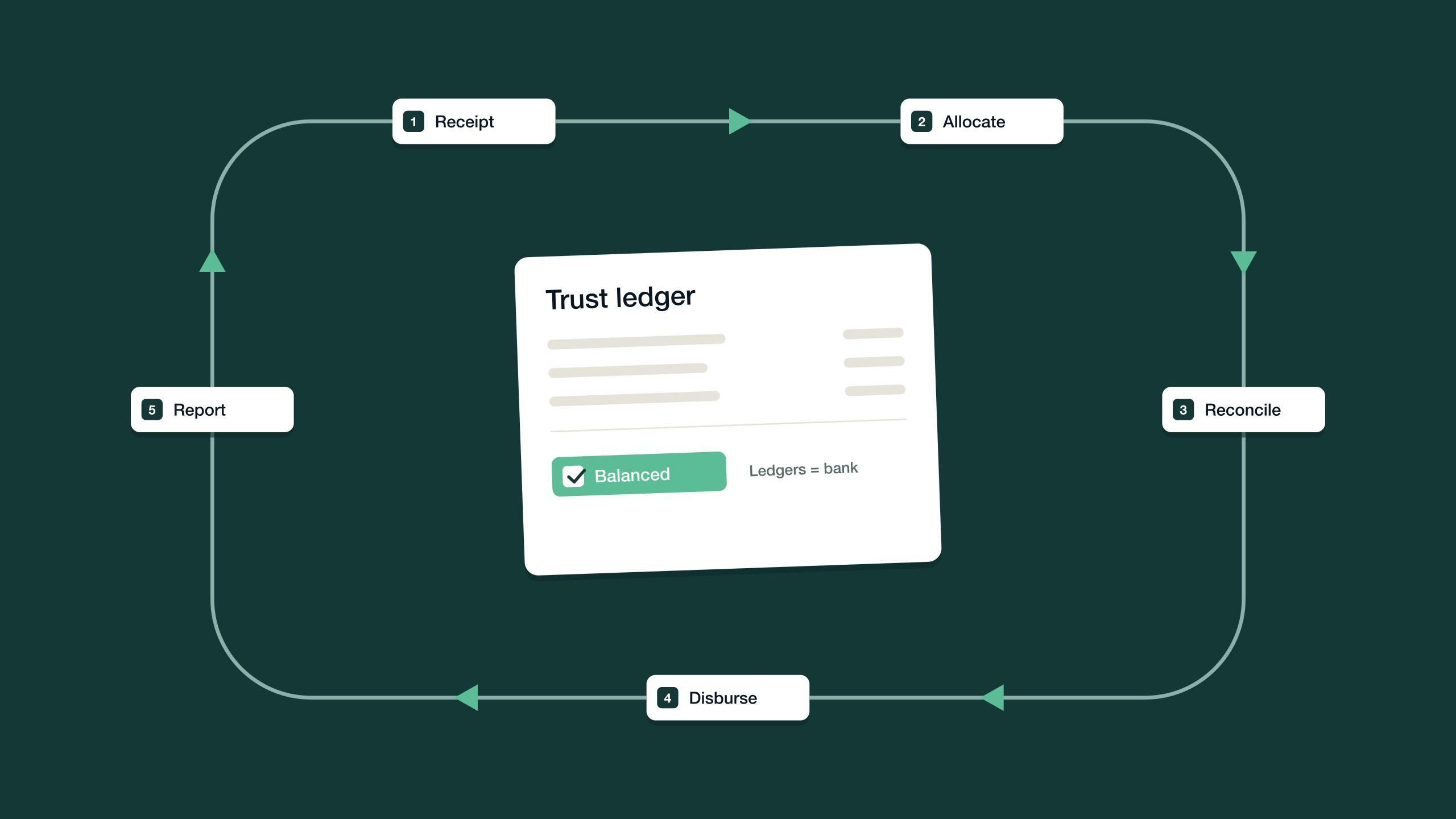
Money & accounting
Trust accounting for short-term rentals: the complete guide
· 18 min read
 Ryan J
See it on your own listing. Free, from one link.
Paste an Airbnb listing and we'll show you what it could look like — a rewritten title, description, photos and a task list from your reviews.
- Syncs with every channel
- Cancel anytime
- AI agents with Pro