How to respond to Airbnb reviews (templates for good and bad)
Your review replies are read by the guests deciding whether to book — not the ones who already stayed. A three-move framework, six copy-paste templates, and the mistakes that quietly cost bookings.

Ryan J
Co-Founder, PropertyStack · · 15 min read
Contents
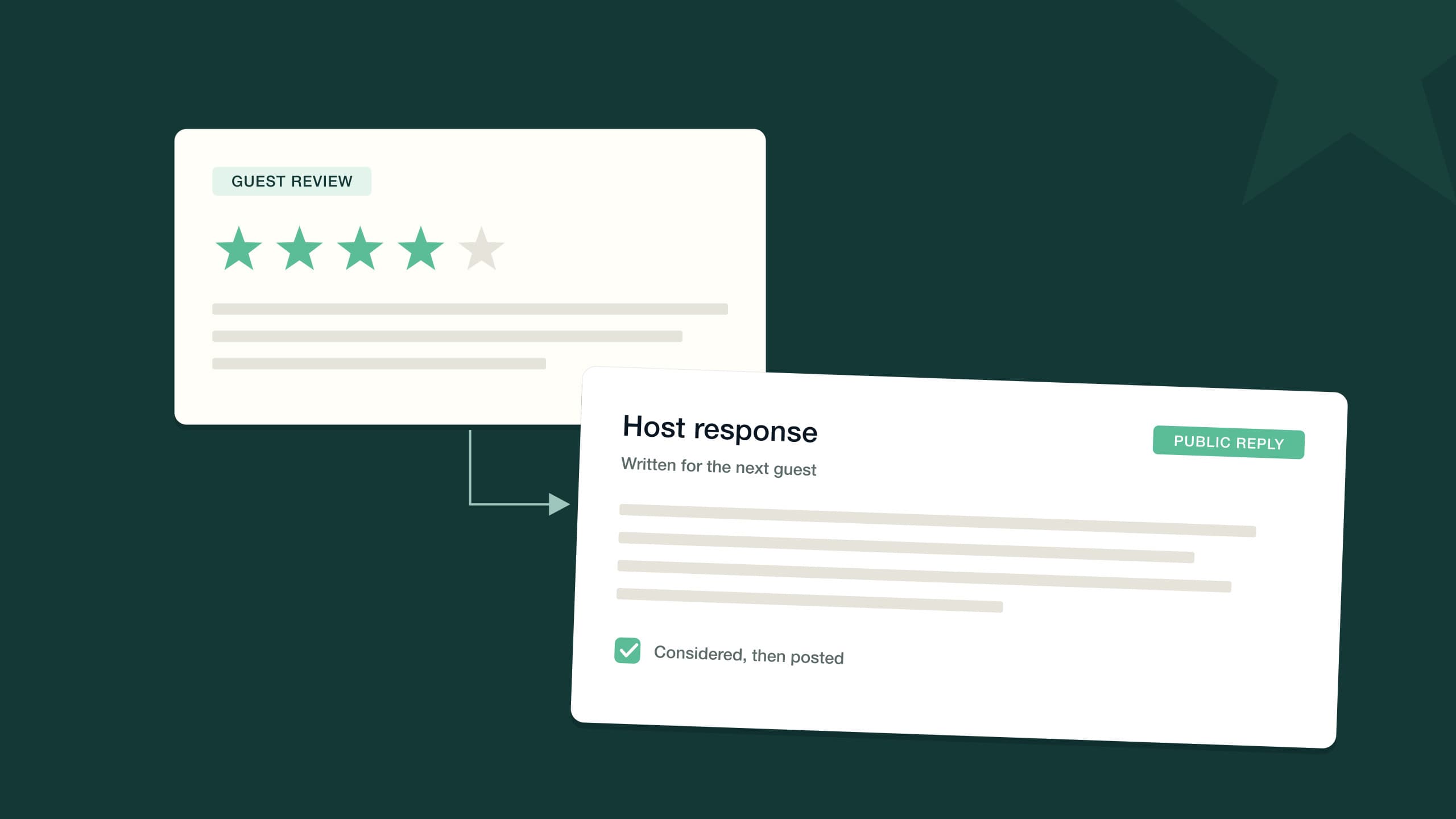
Most hosts write review responses for the wrong reader. The guest who left the review has already checked out, already scored the stay, and may well never open your listing again. The people who will read your reply — carefully, and at the exact moment they're deciding whether to book — are your future guests.
That reframe changes everything about how you respond to Airbnb reviews. A reply to a glowing review isn't just good manners; it's a chance to repeat, in your own words, the thing your best guests love about the place. A reply to a negative review isn't damage control aimed at one unhappy guest; it's the only spot on your listing where you get to show every future guest how you behave when something goes wrong.
This guide covers the whole job: why responses matter, how the response window works, a three-move framework that fits any review, six host review templates you can adapt in minutes — from the five-star rave to the review that's flat-out wrong — and how to automate the routine without losing your voice — one piece of the broader Airbnb automation picture.
Why do Airbnb review responses matter?
A review response is the most public writing a host ever does. Your listing description is read by people considering your place; your reviews are read by people deciding. By the time someone has scrolled deep enough to find your one negative review from March, they are close to booking — and what you wrote underneath it is the tiebreaker.
Prospective guests read reviews the way employers read references: they discount the praise a little, then hunt for problems. When they find one, the review itself answers "what went wrong?" — but your response answers the question they actually care about: "what happens if something goes wrong for me?" A calm, specific, generous reply to criticism tells them that problems at your place get fixed. Silence tells them nothing. A defensive rant tells them to keep scrolling.
You're not replying to the guest who left. You're advertising to the guest deciding whether to arrive.
Responding to positive reviews matters for a quieter reason. It signals an attentive host — the same signal fast message replies send before booking — and it lets you name the things you want associated with the property. If a guest raves about the outdoor bath and you mention it warmly in your reply, the amenity gets described twice on the same screen, once in their words and once in yours. When you respond to guest reviews consistently, the response column itself becomes part of your listing's marketing.
How does the review response window work?
The mechanics are simple, and worth getting straight before you write a word. Once a guest's review is published, you can post one public response, and it appears directly beneath the review on your listing. It isn't a message to the guest — it's a permanent caption on their words, shown to everyone who reads them from that day on.
Two properties of that response shape how you should write it. First, it doesn't change the score: the star rating stands, and the review stays. The response's job is context, not correction. Second, treat it as final copy: assume you won't get to rewrite it later. Draft it somewhere else, sleep on anything written while annoyed, and post it when it reads well cold.
Remember, too, that responses are read in a column, not in isolation. Someone scrolling your reviews sees every reply you've written, one after another. That column has a tone — measured or prickly, human or canned — and future guests absorb it in seconds. Each response is a paragraph in a document you are permanently publishing.
Platforms set their own time limits on when reviews publish and how long you have to respond, and those rules change — check the current policy in your hosting dashboard rather than relying on what was true last year. The safe habit is to respond within a few days of publication regardless: the details are fresh, the reply reads as attentive rather than obligatory, and the review never sits unanswered in front of prospective guests.
One more distinction: the public response is not the place to resolve anything. If a stay went wrong and there's something to make right with the guest — a partial refund, an apology, a fuller explanation — do that privately, through the platform's messaging. The public reply then only has one job left: telling the next guest what kind of host runs this place.
A response framework: acknowledge, add detail, close forward
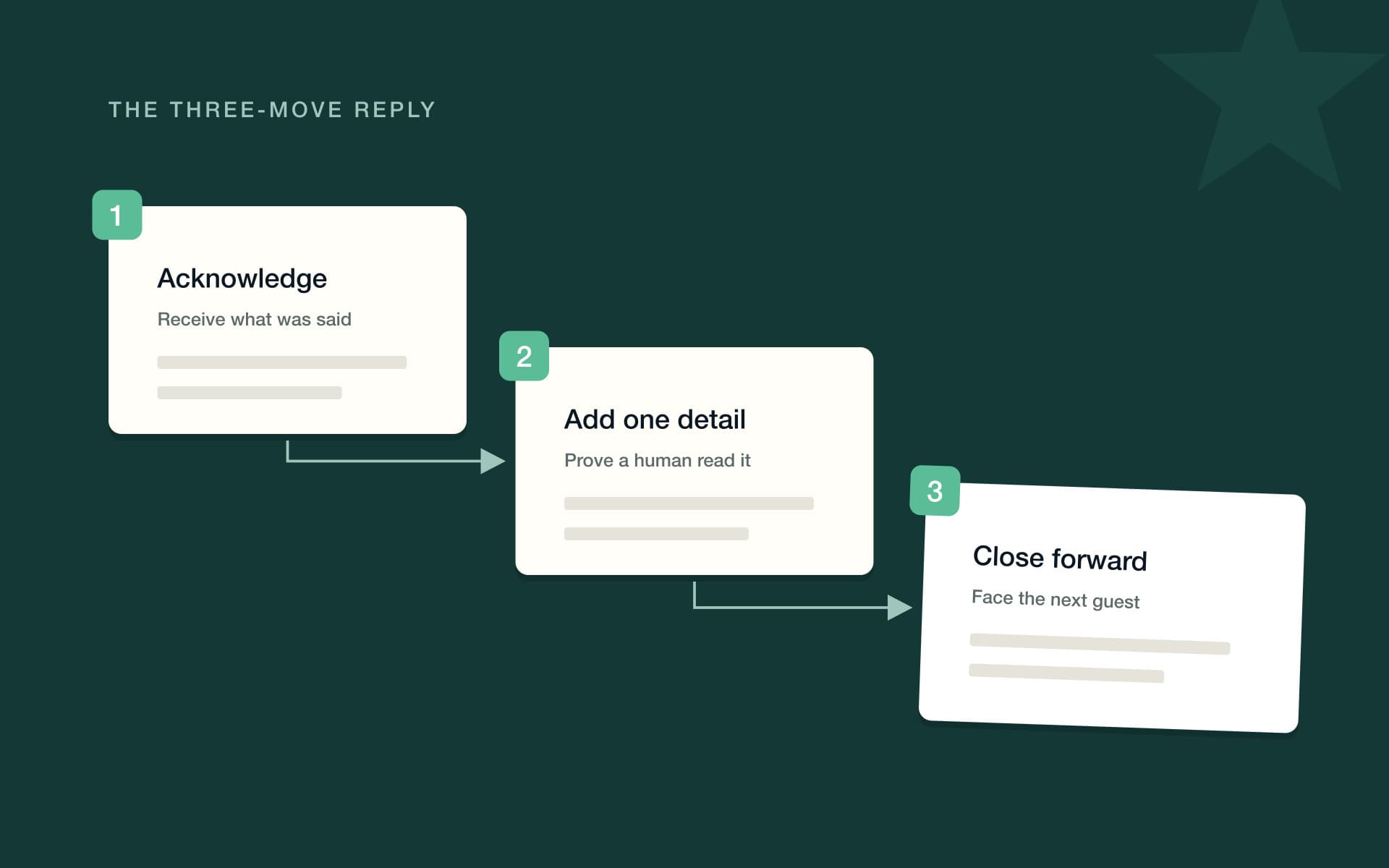
Every good review response — positive or negative, two lines or ten — makes the same three moves in the same order. Once you see the pattern, you can write a strong reply to any review in a few minutes, and you can spot exactly why a weak one feels off.
1. Acknowledge what the guest said
Open by receiving the review, whatever it says. For praise, that's a genuine thank-you. For criticism, it's acknowledging the guest's experience — "we're sorry the first night was cold" — which is not the same as conceding every claim. You can acknowledge that a stay felt disappointing while still, later in the reply, correcting a fact. What you can't do is skip this step: a response that opens by arguing has already lost the future guest's sympathy.
2. Add one specific detail
The middle of the response proves a human wrote it. Name the thing they praised, the issue they hit, or something you remember about their stay. "Thanks for the lovely review!" could be pasted under any review of any property on the internet — and reads that way. "We're glad the fire pit earned its keep on those cold nights" could only belong to this review of this place. Specificity is also where the marketing lives: the detail you choose to repeat is the detail the next guest remembers.
3. Close facing forward
End with the future, not the past: what changed because of the feedback, what the guest can expect next time, or a plain welcome back. This is the sentence most obviously addressed to the next reader — "we've since added a second heater to the back bedroom" is information a past guest doesn't need and a future guest quietly files away. Never close by relitigating; close by moving on.
Calibrate the length to the review. A two-line rave earns a two-line thank-you; a detailed critique earns a fuller reply. What stays constant is the order of the moves — and the discipline of making each one exactly once. Acknowledge once, not three times. One detail, not an inventory. One forward-looking close, then stop writing.
Airbnb review response examples for every scenario
The six templates below follow that framework. Swap the bracketed prompts for your details, then edit until it sounds like you — a response that reads like it was stamped out by a machine does more harm than no response at all. Vary your openings across reviews, too: a column of replies that all start "Thank you for your feedback" tells future guests nobody's really home.
The glowing 5-star review
The easiest reply to skip, and the cheapest marketing you'll ever write. Keep it short, warm and specific — pick the one detail from their review you most want the next guest to notice, and repeat it. Resist the urge to list every amenity; one loved thing, named twice on the same screen, beats a brochure.
The 4-star review with one critique
Four stars with a small gripe is a gift: a guest who liked the place enough to book again, handing you a fixable flaw and an audience to fix it in front of. Thank them for both halves, own the critique without drama, and — if you've already addressed it — say so plainly. "Already handled" is the strongest sentence in review ops.
The mixed review
A genuinely mixed review — some things loved, some things not — deserves a reply that mirrors its balance. Don't cherry-pick the praise and ignore the rest; future guests notice selective hearing. Address both, then use the close to hand useful context to the people reading before they book.
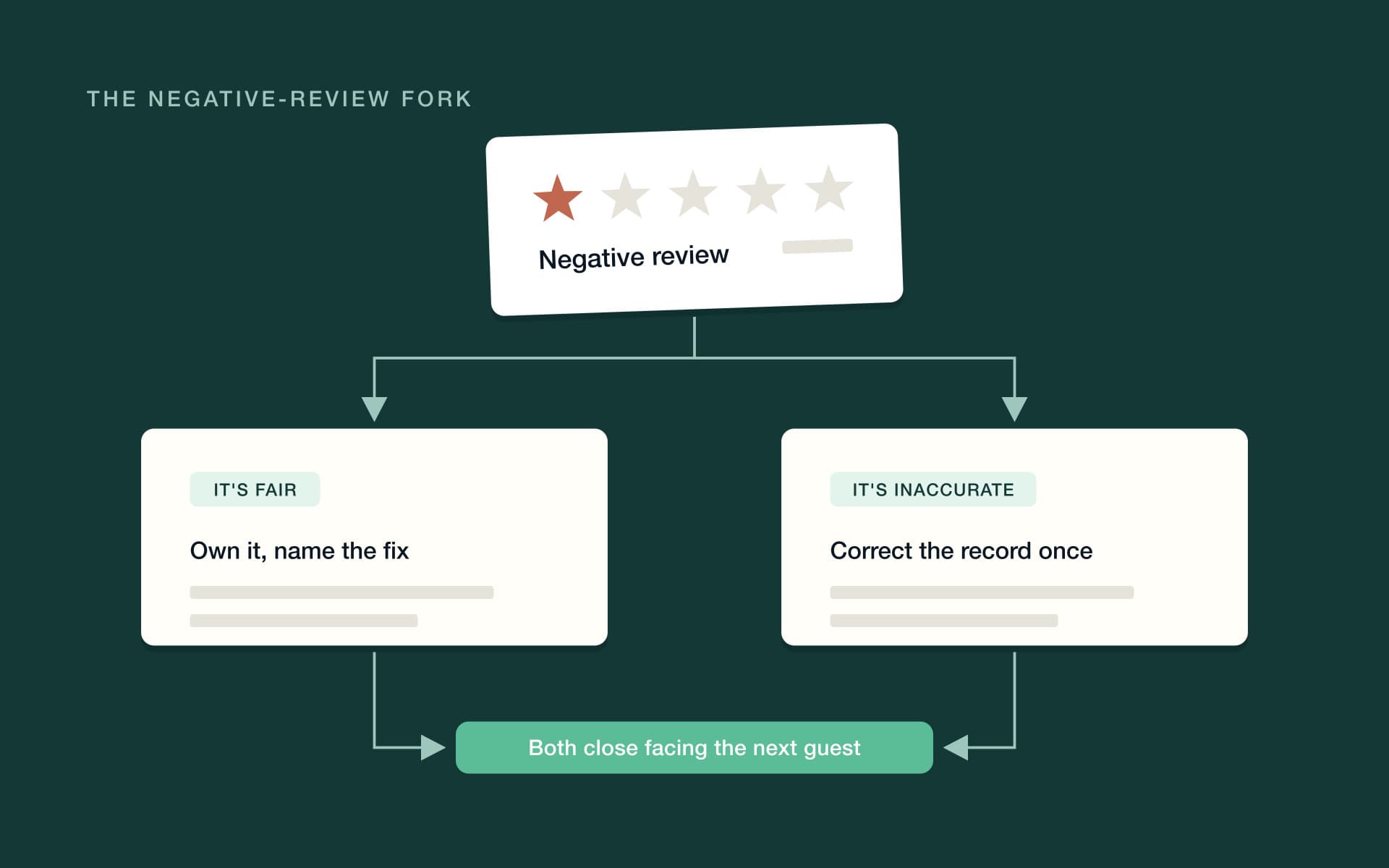
The unfair or factually wrong negative review
This is the one hosts dread, and the one future guests read most closely. A negative Airbnb review response succeeds on tone: correct the record once, flatly, with evidence you actually hold — message timestamps, work orders, photos on file — and spend zero sentences on how the review made you feel. If the review genuinely breaches the platform's review policy, report it through the official process too, but write the public response first and write it as if the review will stand, because it usually will.
The legitimate negative after a real failure
When the criticism is simply true, the strongest available move is agreeing with it. No hedging, no "we're sorry you feel that way" — a real apology, one sentence of ownership, and the concrete thing that changed. Future guests don't expect a property with zero failures; they're checking whether failure gets met with honesty. This is the response that can turn your worst review into your most persuasive one.
The review that mentions a maintenance issue
Maintenance mentions age badly if they go unanswered — a two-year-old review about a dripping shower reads as current information until you say otherwise. The reply has one essential job: timestamp the fix. Say it was repaired, say when, and say what now prevents it, so the next reader knows the issue lives in the past.
What should you never write in a review response?
Every rule in this list exists because a future guest is watching. None of these make the review better; all of them make the response worse than silence.
- Arguing point by point. A line-by-line rebuttal reads as a host who fights guests. Even when you win the argument, you lose the booking.
- Blaming the guest. "You didn't read the house manual" may be accurate — and it tells every future guest they'll be blamed too.
- Private details. Payment disputes, damage claims, ID problems, anything personal about the guest — a public response is the wrong place, full stop. It reads as retaliation and can breach the platform's content rules.
- Sarcasm. It lands on the reviewer as contempt and on future guests as a warning.
- Bargaining over the review. Offering refunds or discounts in exchange for changing a review looks desperate in public — and review manipulation is against platform policy anyway.
- The wall of text. A 400-word defense of a 40-word review signals the criticism hit something true. Roughly match their length, then stop.
The test for every sentence you're tempted to keep: does this make the next guest more likely to book, or less? If the honest answer is "it makes me feel better," cut it.
Turning review patterns into operational fixes
Responding closes the loop in public; fixing closes it in reality — and only one of those stops the next bad review. Read your reviews as a defect log, not a report card: one mention of an issue is an opinion, two is a coincidence, three is a work order. Recurring themes deserve an owner, a task and a due date, not another well-written apology.
| What reviews keep saying | What it usually is | The fix |
|---|---|---|
| "Check-in was confusing" | An instructions problem, not a guest problem | Rewrite the arrival guide; send it earlier; photograph every step |
| "Hard to reach the host" | A coverage gap across channels or hours | Route every channel into one inbox with someone — or something — on it around the clock |
| "Not as clean as expected" | Turnover quality drifting between cleaners | Photo checklists per changeover, spot checks, one accountable owner |
| "Bed was uncomfortable" | A capex decision being deferred one stay at a time | Replace the mattress; it's cheaper than the ratings slide |
Then watch the trend, not the incidents. A single rating is noise; the direction of your rating over months is the verdict on whether the fixes are landing. If the check-in complaints stopped after you rewrote the arrival guide, the review column just confirmed a process change — that's the feedback loop doing its job.
Prevention beats response, and most negative reviews are really communication reviews wearing a costume — the broken heater mattered less than the day of silence that followed the report. Getting every channel into a unified inbox that keeps every conversation in one thread removes the missed-message failure mode, and an AI guest messaging agent answers routine questions and manages mid-stay issues around the clock, escalating to a human only when needed — so problems get handled while they're still messages, not yet reviews.
The same logic applies upstream of the review: the messages you send during the stay set up the review a guest writes after it. If yours need work, start with our Airbnb message templates for every stage of the stay and fix the inputs before polishing the outputs.
Automating review responses without losing your voice
At a couple of properties, responding to every review is a pleasant weekly habit. Across a growing portfolio it becomes a queue: new reviews arriving on multiple channels, each deserving a specific, personal reply within days, each negative one needing a cool head and a records check. This is exactly the shape of work that slips — not because it's hard, but because it's constant.
PropertyStack, an agentic property management platform for short-term rentals, treats this as agent work. The reviews agent handles automated Airbnb review management end to end: it requests reviews at the right moment, responds to every review, turns negative feedback into action items for your team, and tracks your rating trend so you can see whether the fixes are landing — working with your reviews on Airbnb and Booking.com.
Automation shouldn't mean publishing without oversight. You set guardrails and approval thresholds per agent — you decide what runs automatically and what waits for your sign-off, and the AI escalates to a human when something genuinely needs one. A sensible split: let replies to positive reviews flow on their own, and hold anything critical for a human read before it goes public. You keep the judgment; the agent keeps the streak.
Frequently asked questions
The short version, for the questions operators ask most.
Platforms set their own windows for posting a public response, and the rules change over time — check the current policy in your hosting dashboard rather than relying on old advice. As a working habit, respond within a few days of publication, while details are fresh and before prospective guests read the review unanswered.
No. A public response doesn't change the star rating or remove the review — it adds your side of the story directly beneath it. That's still worth doing: future guests read responses closely when deciding whether to book, especially under critical reviews.
Yes. A short, specific reply to a five-star review signals an attentive host and lets you repeat the detail you most want associated with the property, in your own words, right where future guests are reading. Skipping them leaves easy marketing on the table.
Stay calm and write for future guests, not the reviewer. Acknowledge the experience, correct any factual errors once and flatly, apologize genuinely where the criticism is fair, and close with what changed. Keep it roughly as short as the review itself, and resolve anything personal privately instead.
Yes. PropertyStack's reviews agent requests reviews at the right moment, responds to every review, turns negative feedback into action items and tracks your rating trend, working with Airbnb and Booking.com reviews. You set guardrails and approval thresholds, so you decide what publishes automatically and what waits for your sign-off.
Still have questions?
Ask PropertyStack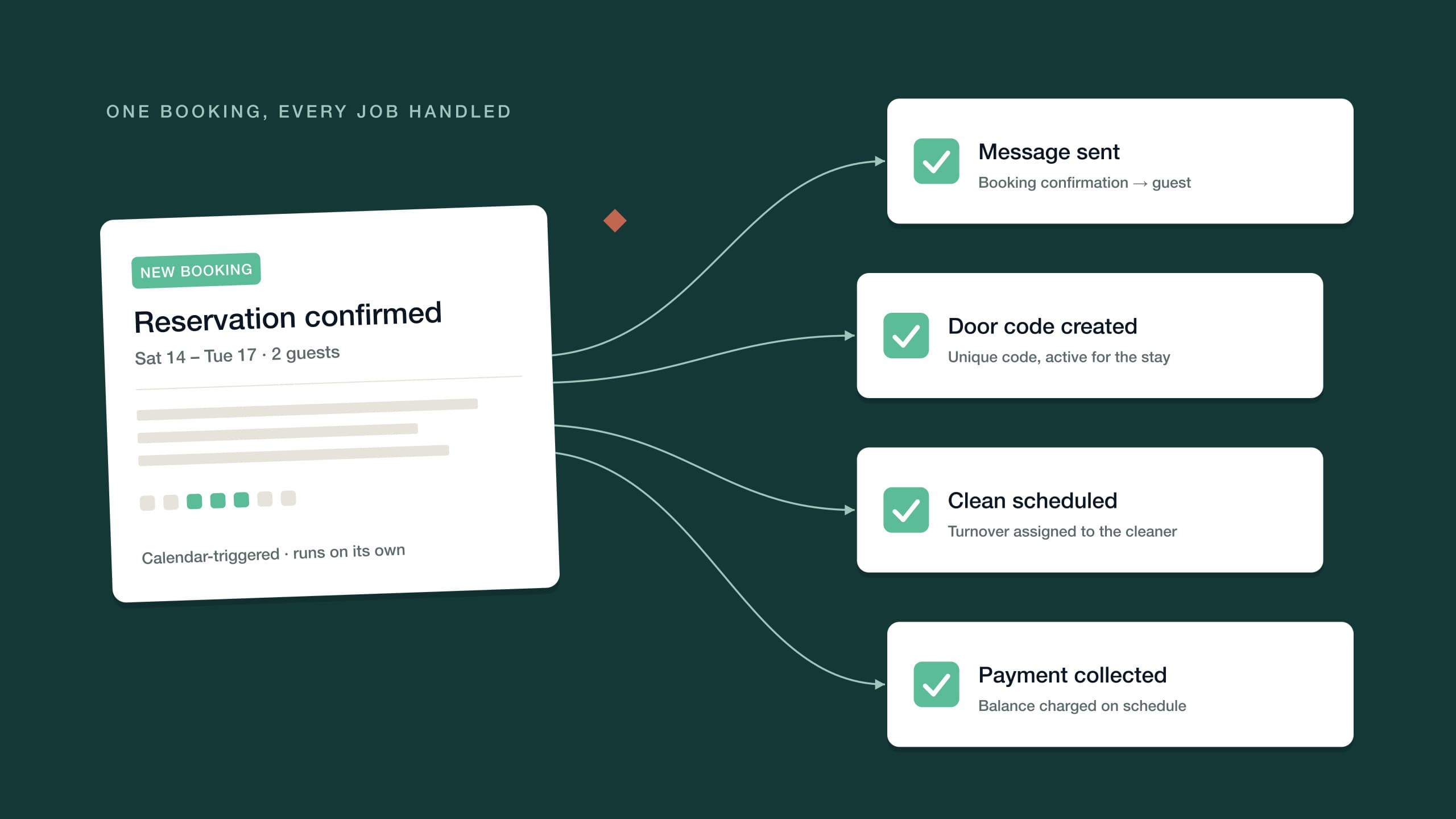

See it on your own listing. Free, from one link.
Paste an Airbnb listing and we'll show you what it could look like — a rewritten title, description, photos and a task list from your reviews.
- Syncs with every channel
- Cancel anytime
- AI agents with Pro